From a single grain of wheat

Shigesato Itoi ☓ Akira Minagawa

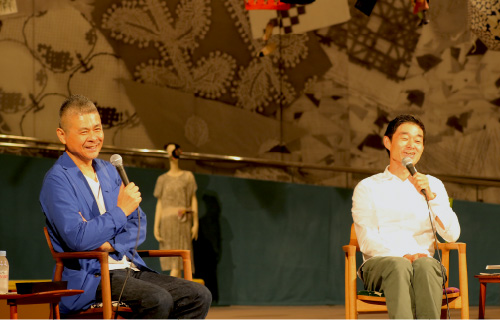
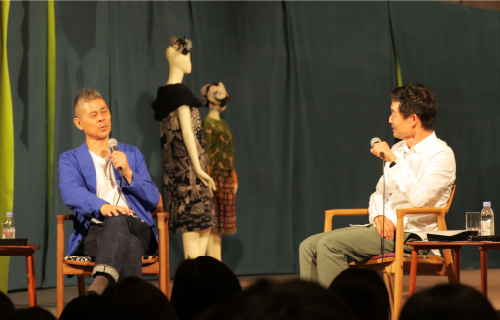
minä perhonen is a meticulously-designed clothing brand beloved by many people for its use of original textiles. This special panel by Shigesato Itoi and designer Akira Minagawa was held during minä perhonen's special gallery event to celebrate the brand's 20th anniversary. They discuss the origins of the Hobonichi Techo, the important points of creating clothing, and other topics that popped up during their casual conversation.

About minä perhonen

Fashion brand created by designer Akira Minagawa.

First founded in 1995 under the name minä. Opened the first shop in Shirokanedai, Tokyo in 2000, and renamed the brand name to “minä perhonen” in 2003. Opened a total of 9 shops across Japan, with a new location in Daikanyama in April 2016, a new shop in the Spiral building in Aoyama, Tokyo in July 2016, and a location coming to Kanazawa.

minä perhonen homepage

Part4

Turning Orthodox on its head

Itoi
Fashion is a career that involves releasing a large amount of ideas on a regular basis, and in a way that seems to be merely reproducing works, but isn’t actually the case. And when I think of a job that involves mass production, the one that comes to mind is a songwriter. If you hit it big as a songwriter, you’ll be drowning in more work requests, and you’ve got to create a huge amount of song lyrics.
Minagawa
Yes.
Itoi
And, presumably, you’ll reach the end of that peak of success after a few years. You’ll have probably used every possible instance of words like “wind,” and “love.” Although they can make a variety of lyrics by changing the scenarios and situations of the song, after a while you’re able to recognize certain patterns in their work. At that point, the companies hiring them either think that it’s time to move on to someone else, or the songwriter is exhausted and ready to quit. I’ve seen a lot of instances of things ending badly like that when songwriters mass produce lyrics.
Minagawa
I see.

Itoi
But I’m sure people in the fashion industry last longer than songwriters do despite mass-producing their own work. I wonder how they can do that?
Minagawa
I wonder.
Itoi
Maybe it’s because it turns into a team project halfway through.
Minagawa
That might have something to do with it. I sketch up my own designs, but when I’m talking with fellow designers in the studio, I sketch up my own designs, but I sometimes find myself subconsciously drawing things based on what I talk about with designers in the studio.

Itoi
Have you ever had a new motif or foundation for a piece come together by critiquing a fellow designer’s work?
Minagawa
Yes, we’ve had that.
Itoi
Right? Like if you’re sitting in an art studio with someone and see them drawing a design for a window, and you lean over and ask, “Is that supposed to be a window? Wouldn’t it be like this, then?” And then a new design comes out of that.
Minagawa
Yeah. I’ve also had times when for some reason or other, I suddenly remember something that’d been on my mind.
Itoi
As long as you’re surrounded by people with high standards, it’s times like that when you can really get some fun designs together.

Minagawa
That’s true. I often work with ideas that are floating around the studio rather than relying solely on clumping together my own personal ideas.
Itoi
Do you ever find yourself reverting back to the classics when you can’t come up with any original ideas? A musician, for example, might suddenly start performing classical music. Like covering up an inability to come up with new ideas by hiding behind something orthodox, and saying “Turns out that normal is best!” to disguise your creative exhaustion.
Minagawa
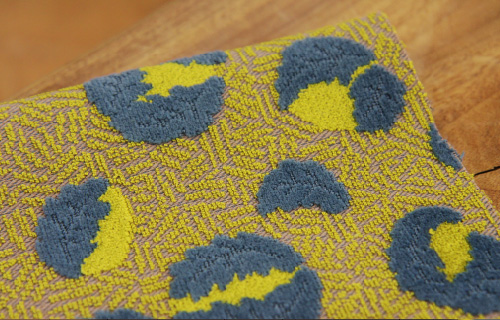
I’d say it’s actually harder to work with the classics to try and fit that into your own style. For some reason or another I released a leopard print last year. Usually, leopard prints are really popular and people have an easy time envisioning it, but when it was a minä perhonen leopard print, that made it more interesting.
Itoi
Ooh, a minä perhonen leopard print.

Minagawa
I was surprised with the result when I tried making it myself. It was actually more difficult than working on a pattern from scratch. It actually took years of work to finish the leopard print.
Itoi
Oh, really?
Minagawa
Same goes for the checkered design I released this year. It wasn’t just a series of horizontal and vertical lines. I complied a number of squares to make it look like a plaid design. When working on an orthodox design, it ends up taking a long time to find your own personal technique for creating that established style, and often doesn’t turn out quite like it should despite repeated efforts.
Itoi
So it takes a lot of thought, and a lot of perseverence.
Minagawa
Right.
Itoi
And you can’t reveal it until it’s ready.
Minagawa
Right. It takes years of work to take an Argyle check or Paisley pattern that everyone knows and turn it into something brand new.
Itoi
Wow, that’s amazing.
Minagawa
But one day, it’ll just kind of fall into place. One time, I saw a tree in the distance that looked to me like a leopard print. When I got closer, I saw it was just from the fruit in the tree being wrapped in the tree leaves. And that was what it took for me to finish the design.

Itoi
Hm.
Minagawa
It was at that point that I finally felt I was able to create a leopard print that was uniquely my own. I was never able to reach that point when I was chasing it head on, but being able to turn orthodoxy on its head like that is a joyful thing.
Itoi
So it’s not about fleeing to the safety of the classics, but wrestling with them until you have a clear winner and loser. I’m sure it takes a strong spirit to be able to pull that off.
Minagawa
From that end, minä perhonen doesn’t really have anything to do with current trends or anything, so if we don’t win that battle the first time, we can delay it to the next season, or even pass it off to the next generation if we can’t settle it in our lifetime. So it’s very important for me that I stick with it and continue to mull it over.
Itoi
You’ve gotta stick with it.
Minagawa
Ideas just pop into my head all of a sudden. But giving them shape is an ongoing, maybe even perpetual process. There are all kinds of barriers to cross and conditions to overcome, but the most enjoyable part of making something is seeing the result of what starts as a sudden unexpected flash make its way toward eternity.
Itoi
That’s very true.
Minagawa
You mentioned earlier that you weren’t entirely certain if it had to be a techo. But looking at how you’ve been continuing to make the techo since its inception, and the possibility that it will continue on in the future for even longer than these years you spend on it, I’m just amazed.
Itoi
For sure.

Minagawa
You’re also running the TOBICHI shop, which allows customers to see the products from your online shop in person.
Itoi
Yes. We wanted to create a space where we could meet people. In the past we’ve often exchanged e-mails with our readers and hosted events where we could meet everyone face-to-face, and we’ve always felt incredibly glad to have done so.
Minagawa
Yeah.
Itoi
At first we just wanted to have a place to sell our products and make our customers happy. But we realized how much easier it would be to come up with ideas for projects if we were to make people happy with more than just selling products. For example, there are several minä perhonen shop locations, but if we were to invite you to TOBICHI to work with us on something, perhaps that would spur you to come up with some ideas for what you’d like to do.
Minagawa
Oh yes, I’ve already got a few. [Laughs]

Itoi
Oh, really? [Laughs] In the past you’ve worked with us on a workshop at the Hobonichi Kessennuma branch. One of the cues we reference for TOBICHI is the fact that by having a gathering place, people will come, and there’s a certain joy in that.
Minagawa
It’s especially exciting in this day and age to have a place where you can experience new things firsthand.

2016-12-06-Tue

BACK | Part 3