Why I Write Stories

Talking with Hirokazu Koreeda
about Our Little Sister and other works.

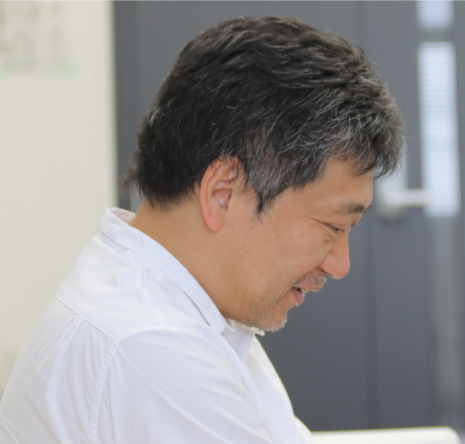
Hirokazu Koreeda

Born 1962 in Tokyo. In 1995 he won the Golden Osella award for his directorial debut, Maborosi. In 1998, his film After Life was released in 30 countries around the world, including 200 theaters in the United States. His 2004 film Nobody Knows made its star, child actor Yuya Yagira, the youngest-ever winner of the Best Actor award at the Cannes Film Festival. Koreeda also worked on Hana (2006), the Blue-Ribbon-award-winning Still Walking (2008), and Air Doll (2009), which was featured in the Un Certain Regard selection of the Cannes Film Festival. In 2011, won the San Sebastian International Film Festival Best Screenplay Award for his film I Wish.His highly acclaimed film Like Father Like Son, starring Masaharu Fukuyama, won the Jury Prize at the 2013 Cannes Film Festival and…

…launching the production company BUN-BUKU,INC. 
Part2

A Story of Equivalence

There really is a family theme running through your previous work, like I Wish and Like Father, Like Son. Do you have any particular views on family?
Koreeda
Nothing in particular, actually.
Really?
Koreeda
Yeah. I don’t hold any particularly unique family values. But when I shoot scenes of families, I just keep in mind that families are annoying, yet irreplaceable.

Family’s irreplaceable, but that’s not all.
Koreeda
Yes, it’s sometimes irritating. There are many things made more difficult by blood ties. So I like to show both sides of what it is to be “family.”
Yes, there are all kinds of family difficulties in your movies, like the husband-and-wife relationship in I Wish.
Koreeda
But that’s really all there is to it. I’m not trying to propose any overarching theory. I’ve come to realize, now that I have a family of my own, that I’m actually quite conservative.

Really? What do you mean by that?
Koreeda
For example, when I attended the sports day at my child’s school, I tried to cut a prototypical fatherly figure. (Laughs)
Do you mean with the way you dressed?


Koreeda
Yeah, I found myself wanting the people around me to see me as a clean-cut, proper father. We can’t all be totally unconventional… unless we’re Yuya Uchida. (Laughs)
Yup. (Laughs)
Koreeda
When I think about how I can’t quite break away from convention… it’s actually more interesting that way.
It’s a big discovery to make about yourself.
Koreeda
When I would drop off my daughter at kindergarten, the school staff would call me “___’s Papa.”
Yeah, they usually do.
Koreeda
My daughter’s friends and their mothers would call me that, too! And I thought, what the heck?
Yeah. (Laughs)
Koreeda
But it was refreshing—it actually made me kind of happy. It even made me happy to be in charge of the kindergarten graduation video. And I was surprised to see myself so pleased by all of it.

So you just kind of noticed all this?
Koreeda
I realized a lot of interesting things about myself. So I’ve tried to keep in mind the various ways and situations in which people are conservative while portraying characters.
So these discoveries make their way into your work.
Koreeda
Before I had a family of my own, I felt I was connected to the world through my work. But after I started a family and became a father, I came face-to-face with a conventionality that I never thought I had when I was young.
Yeah.
Koreeda
Having that personal experience now helps me to avoid creating families that seem more like academic concepts than real people.
The father in I Wish, played by Joe Odagiri, is a washed-up rock musician. That’s not a conventional family.


Koreeda
That’s right.


He’s very cool, as far as father figures go.
Koreeda
Yeah.
And even though he was not like my own father, he didn’t seem unrealistic. Perhaps it felt realistic because of what you said earlier, about family being a pain but also irreplaceable. Or because peoples’ natural conservatism shows through. Or because you portrayed both sides, the whole picture.
Koreeda
Hm… I’m not sure. Maybe it’s just because I don’t portray unusual situations as particularly unusual.
I see. That would explain why the unusual circumstances in I Wish and Like Father, Like Son don’t feel unrelatable.


Koreeda
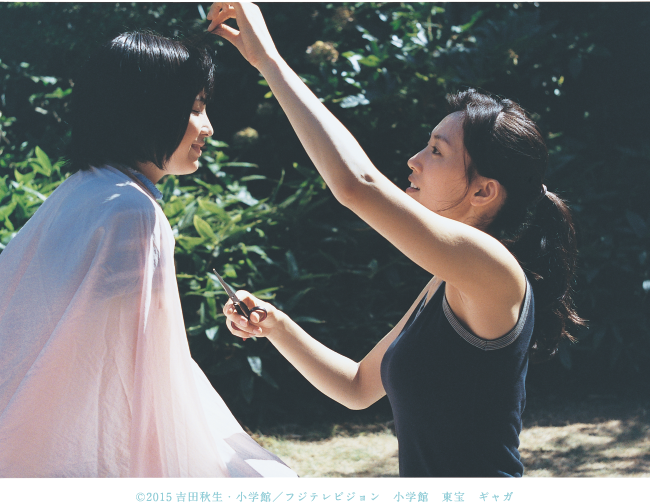
If you think about it, there’s something quite awful happening in Our Little Sister.
That’s true.
Koreeda
In real life it would be an enormous undertaking to take in your half-sister after your father abandoned your family for another woman.

Yeah.
Koreeda
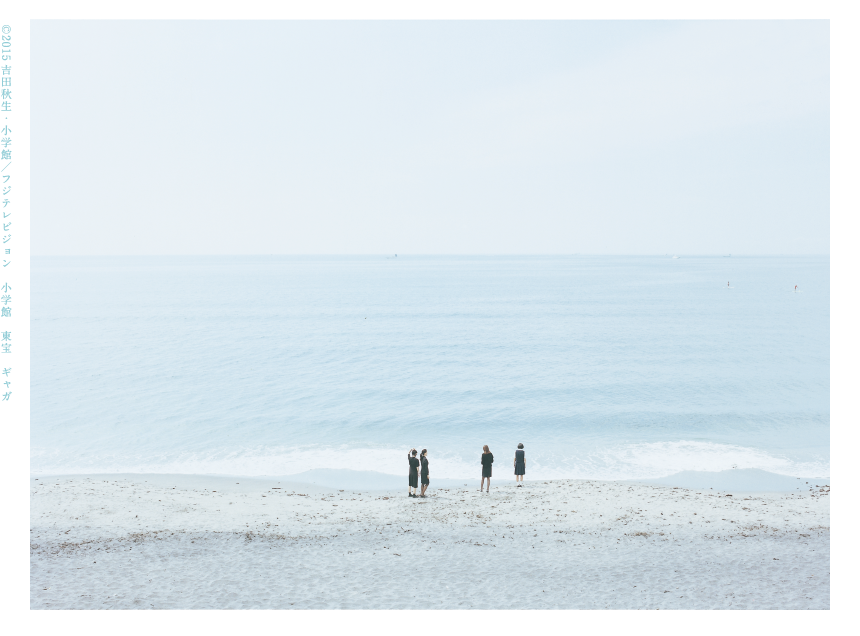
There was a reason we didn’t portray that unique set of circumstances in a dramatic way. It’s because each event is a single page in a diary. One page is about living with their half sister, another is about drinking plum wine together, another is about riding a bike through a path lined with cherry blossom trees.
Oh, you’re right!


Koreeda
And another page was about losing someone close. Situations may contain a mixture of darkness and light, but they’re all equal. Meeting someone for the first time, parting ways with someone, and watching a soccer match.
It really is a diary.
Koreeda
In the story, life and death, meeting and parting, are all equal things that come and go. That may have been difficult to portray in a live-action film, but I think that was the greatest charm in the source material, Akimi Yoshida’s original manga.
After talking with you, I can see that the diary pages each turn at the same pace. It’s almost as if there’s a philosophical stance that everything that happens carries equal weight. Have you always felt that way?
Koreeda
I’m not sure. I do now, but I haven’t always. It probably came with getting older.
I see.
Koreeda
Although, really, it’s something that was also in the original manga. I may have just drawn closer to an idea that was already present there.

Ah.
Koreeda
I think I’m more resistant to things, but I’ve started to feel that calm sense that life and death, meeting and parting, are all equal.


Oh, really?


Koreeda
I’ve come to understand that that’s what it means to live life.

2016-12-06-Tue

BACK | Part 1