Why I Write Stories

Talking with Hirokazu Koreeda
about Our Little Sister and other works.

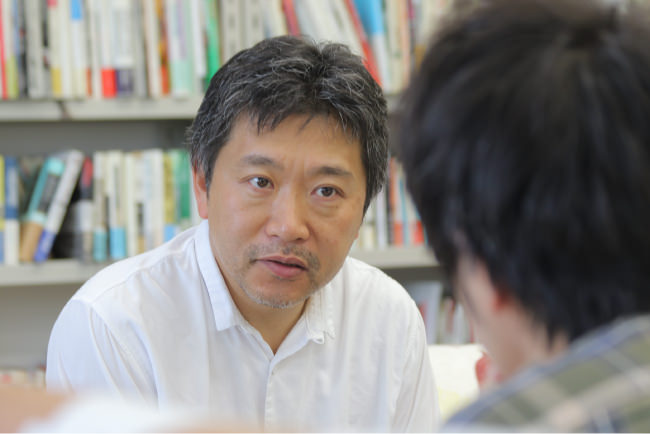
Hirokazu Koreeda

Born 1962 in Tokyo. In 1995 he won the Golden Osella award for his directorial debut, Maborosi. In 1998, his film After Life was released in 30 countries around the world, including 200 theaters in the United States. His 2004 film Nobody Knows made its star, child actor Yuya Yagira, the youngest-ever winner of the Best Actor award at the Cannes Film Festival. Koreeda also worked on Hana (2006), the Blue-Ribbon-award-winning Still Walking (2008), and Air Doll (2009), which was featured in the Un Certain Regard selection of the Cannes Film Festival. In 2011, won the San Sebastian International Film Festival Best Screenplay Award for his film I Wish.His highly acclaimed film Like Father Like Son, starring Masaharu Fukuyama, won the Jury Prize at the 2013 Cannes Film Festival and…

…launching the production company BUN-BUKU,INC. 
Part1

“Death” is one of the themes.


When I saw your film Our Little Sister, I felt like I never wanted it to end.
Koreeda
I was hoping people would feel that way when I was shooting the film.
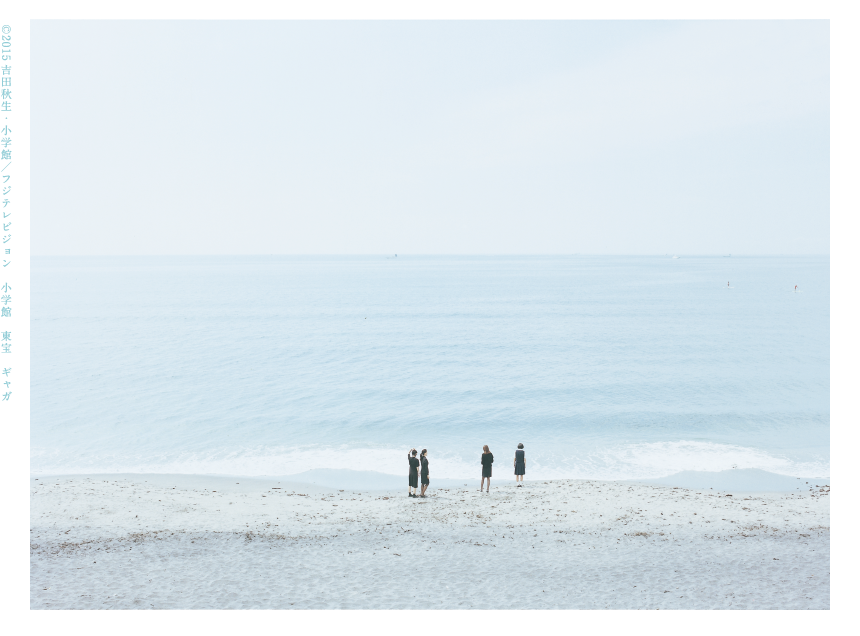
I think that’s exactly the kind of movie it turned out to be. The beach scene at the end, and the way the director of photography, Mikiya Takimoto, shot it, was especially beautiful.
Koreeda
When we were filming that scene, all of us on the staff were hoping we’d be able to communicate that feeling to the viewers.


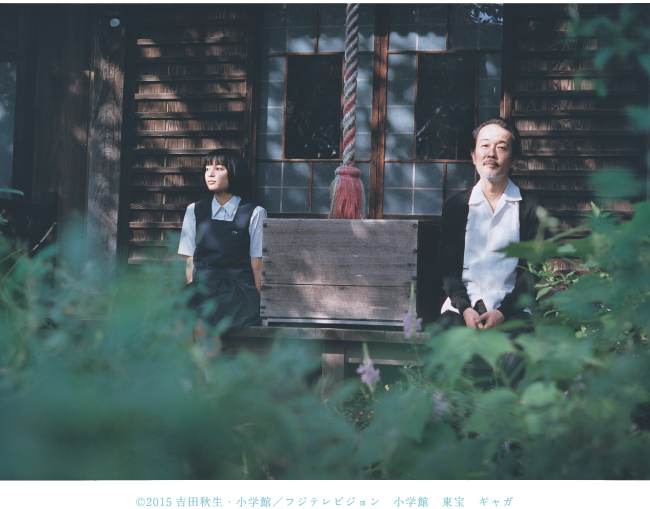
To summarize the movie for readers, it’s the story of three sisters living in Kamakura who take in their half-sister.
Koreeda
Yes.
Is family the theme of the movie?
Koreeda
Although I’ve filmed movies with a focus on family life in the past, this time I actually wanted to broaden my focus and look at a town and the passage of time.
I see.
Koreeda
Of course, it is a story about family, inasmuch as you’re watching four sisters, but it’s also about everyone around them during the long period of time over which the film takes place.
Ever since After Life there’s been a strong sense of the changing seasons in your work. This film also articulates the passage of time. It reminded me that I was watching a Koreeda film.
Koreeda
It does begin and end with a funeral.


There were three mourning scenes.
Koreeda
When I was working on the music with Yoko Kanno, we talked about whether it should sound cheerful or dark. In the end, she said, “I’ll give it a life-to-death ratio of 52 to 48.”
Now that you mention it, there’s definitely a feeling of being stuck in the middle, between the start of something new and parting with something close to you.


Koreeda
Yeah. So I think death is one of the themes of this movie, as well.
Death?
Koreeda
Yes.
I wasn’t sure right as you said that, but now I kind of understand. The overall feeling of the film isn’t at all heavy, but the midsummer scene really stands out. Death is always present in the background—so it’s surprising that it would stand out as a theme of the film, but at the same time it makes sense.
Koreeda
The eldest daughter, Sachi, played by Haruka Ayase, brings back her father through his death.


Brings him back?
Koreeda
Though she’s estranged from her father while he’s alive, effectively losing him once already, after he passes away, and she loses him for real, her younger sister appears. And it’s through her younger sister that she brings back her father. At least, that’s how I read the source material for this film.
I see.
Koreeda
It’s like Sachi is rewriting her own image of her father. Because of his death, she rethinks things and feels closer to him—both things that I’ve had personal experience with.
I understand what you mean about feeling closer to someone after they die.
Koreeda
When my mother died, I began to see her much more in women her age who I’d see around town.
Yeah.
Koreeda
It could be that I was just seeking her out—it wasn’t that everyone really did look like her.
It’s like subconsciously searching for people who look like a certain person, rather than meeting someone who does look like him or her.
Koreeda
It’s like my mother became a universal, or something. I’m not sure, but something definitely changed. It was interesting.
How old were you at the time?


Koreeda
I was 43 or 44 when she died.
What do you think about death?
Koreeda
By the time you get to my age, about half the people who helped make you what you are have passed away.
Hm.
Koreeda
At this point, it doesn’t feel as distant as it once did.


Death?
Koreeda
Death and people who have died. In other words, someone dying doesn’t mean that they’ve gone. You spend a lot more time thinking about them.
Is that what makes them feel closer?
Koreeda
Yes. But it’s not a retrospective kind of thought. When I was young, there was a clear line drawn between life and death. But I don’t feel that’s the case anymore.
Like, death is a part of life, and life is a part of death?
Koreeda
It was only after becoming a parent myself that I thought about the life of my father, who had already passed. I think that’s what was happening to Sachi in the film.
In what ways do you think about your father?
Koreeda
It’s nothing special or profound. Just wondering what he was thinking about when he was working at my age, that sort of thing. There’s a lot I still don’t know about him, but part of me has still come to resemble him.


You personally?
Koreeda
Yeah.
How can you tell?
Koreeda
I just know. But mostly it’s the smell. (Laughs)
Oh, I see! (Laughs)
Koreeda
There are times when I wake up, and for a moment I recognize my father’s scent in the sheets. I don’t really like it, but that’s just the way it is.
The scene in the movie that really stood out to me was when the youngest of the three sisters, played by Kaho, asks their half-sister, played by Suzu Hirose, to tell her all about their father someday.
Koreeda
Yeah, that was a good scene.

2016-12-06-Tue