View in PC modeView in Smartphone mode

HOBONICHI TECHO 2018

HOBONICHI TECHO 2018

The Way of Selection - Taku Sato Style

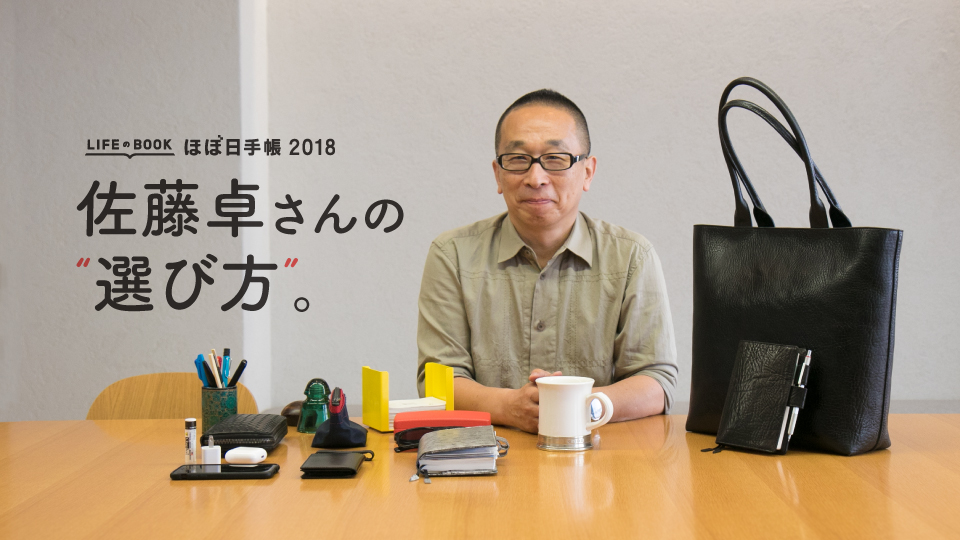
The TS series cover is crafted every year with the leather chosen by graphic designer Taku Sato. Over the years, we’ve witnessed the lightning speed at which Taku chooses the leather from a considerable number of candidates laid out in front of him. Naturally, we grew curious about his mental process of selection. We picked his brain while he showed us his favorite tools and curiosities around his desk as well as the contents of his bag.

Profile

Taku Satoh

Graphic Designer

Graduated from Tokyo University of The Arts in 1979, majoring in design, and completed his master’s degree in 1981.

Joined Dentsu, Inc. before establishing the Taku Satoh Design Office in 1984.

Created product designs and branding for Oishii Gyunyu Milk, Lotte XYLITOL Gum, and much more.

Currently active across a broad spectrum of projects, including general direction for NHK Educational TV’s “Design-Ah” series and art direction for “Nihongo de Asobo.”

Current director of design museum 21_21 DESIGN SIGHT in Tokyo.

Taku Sato Design Office Website
 

Contents

Part3

Inside the bag, up on the desk

Hobonichi:
Today we’d like to find out the workings of your designer’s eyes for selection in your daily life. Could you show us some of your favorite items you use around the desk or have in your bag?
Sato:
Sure, I brought them. Here, I’ll lay it out.
ph2-2

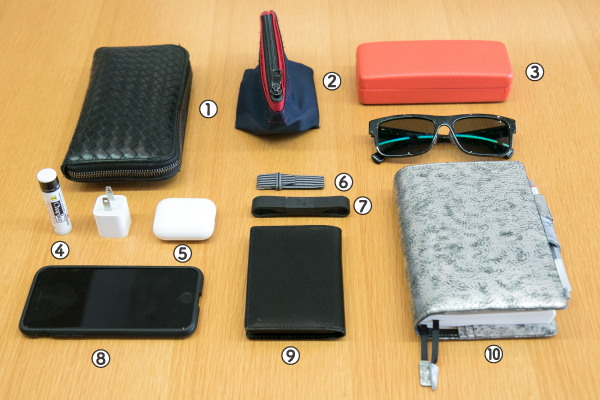
1. Black leather wallet / 2. Lip balm / 3. Wireless earphone / 4. Smartphone / 5. Pouch (to organize small items such as earphones or USB cables) / 6. Toothpick case / 7. Portable USB cable / 8. Black leather card case / 9. Orange sunglasses case / 10. Hobonichi Techo (TS 2017 Black Domopack cover)
Hobonichi:
Nice! Were these all chosen in lightning speed as well?
Sato:
Yes, I’d say so. For instance, I chose the orange sunglasses case for its ease of locating in a bag.
Hobonichi:
These earphones and USB cables are also stylish.
Sato:
These are excellent. The cord doesn’t get all tangled up in the bag. It received the Good Design Award.
Hobonichi:
Your choices reflect your preference for simple and functional design as we’d imagined. Will you show us the stationery set you use around your desk?
Sato:
These are the items I use around the desk. There’s really more… I’ve been using these for so long that I don’t even think about it anymore.
ph2-2

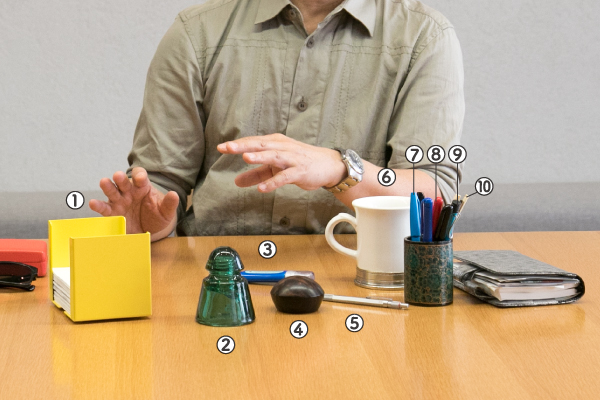
1. Original memo rack / 2. Insulator paperweight / 3. Whiteout / 4. Wooden paperweight / 5.Rotring / 6.Mug / 7. Pentel marker / 8. Pilot V cone / 9. LAMY ballpoint pen / 10.Cutter
Hobonichi:
That fact that you don’t even think it means that you are not using reason; rather, you are “sensing” each item like the talk we had earlier about intuition. Many of these items come in unique shapes.
Sato:
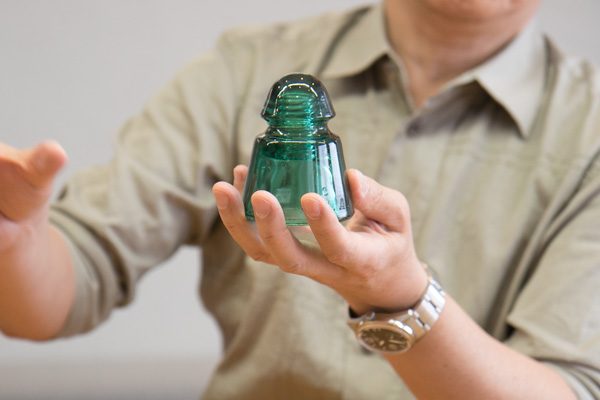
This one here is called Gaishi, an appliance placed at the top of electric poles as an insulator. I encountered many of these in a medley of shapes in an antique shop in Hawaii.

ph2-2

Hobonichi:
I’ve never seen one before.
Sato:
It’s not something you can get a hold of normally, but you can find old ones on the shelves in antique stores sometimes. It comes in a variety of sizes and in such beautiful curious shapes. I find it fascinating and quite cute, using it around the desk as paper weight for loose documents.
Hobonichi:
It’s really charming.
Sato:
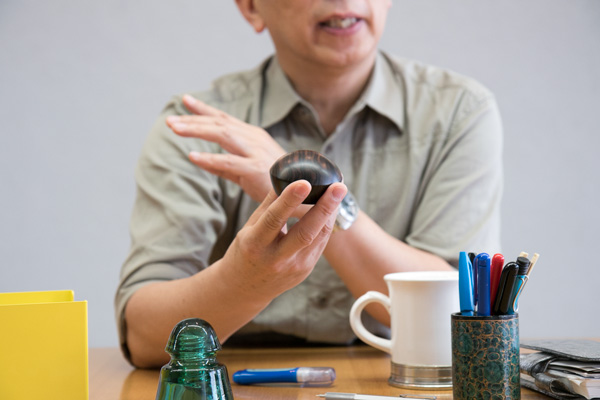
And this one, it’s made in prison.
Hobonichi:
In prison?

ph2-2

Sato:
Kyoichi Tsuzuki, the author of Keimusho Ryohin – Made in Prison (translation: Well-Made in Prison) took me to a market selling products made by prisoners who crafted them under the guidance of artisans. It’s a program to rehabilitate them into society. The stuff I found there was really intriguing. You don’t see designs that are trying to “sell.”
Hobonichi:
I see.
Sato:
It was really amazing! I was pleasantly surprised. I find this paperweight among them. Isn’t it a beautiful shape?
Hobonichi:
Yes. It looks like a piece of art.
Sato:
I have a few a these. It exudes a gentle presence and really handy to use.
Hobonichi:
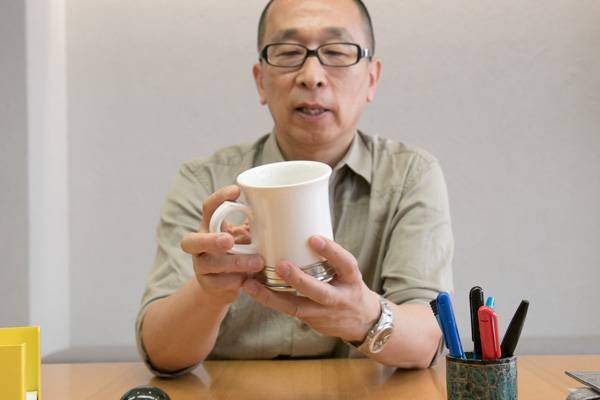
How about this mug?
Sato:
This one I found in Aoyama, Tokyo. I bought it for myself thinking that it’s really special. I gulp up café au lait by the gallon in this mug every morning (Laughs). Don’t you love its texture?

ph2-2

Hobonichi:
Oh, this is from Arts&Science isn’t it?
Sato:
Yes. It’s from the Sonya Park’s shop. This was another love at first sight. It’s got a little scratch but that gives it more character.
Hobonichi:
We know that Rotring is your most favorite stationery which you used with the Hobonichi Techo.
Sato:
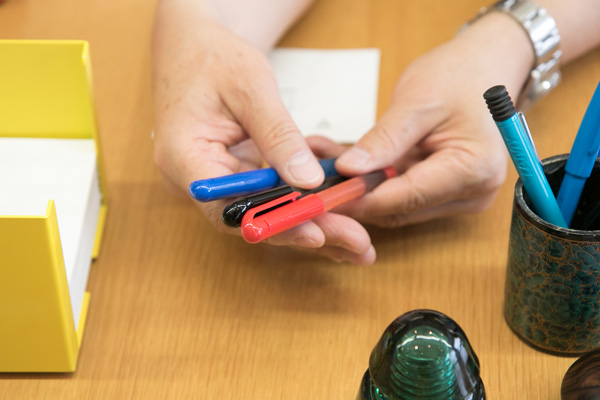
I’ve been using this for so many years now that I don’t’ know how many Rotrings I went through over the years. I also use whiteout and eraser because instead of using a computer I hand draw my designs. My favorite whiteout is this type that releases ink.

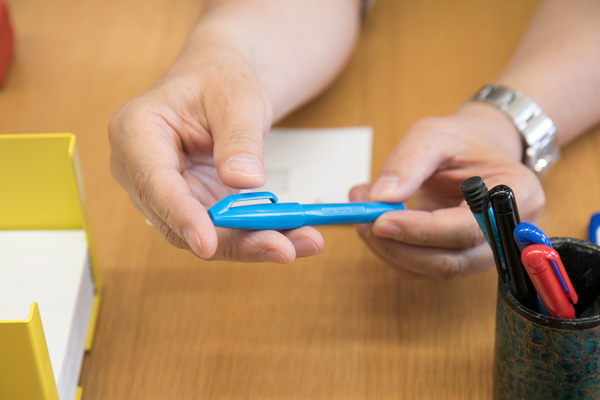
This is Pentel’s marker. Black and red are essentials. The light blue is the original color we made for 21_21 Design Site.
ph2-2

Sato:
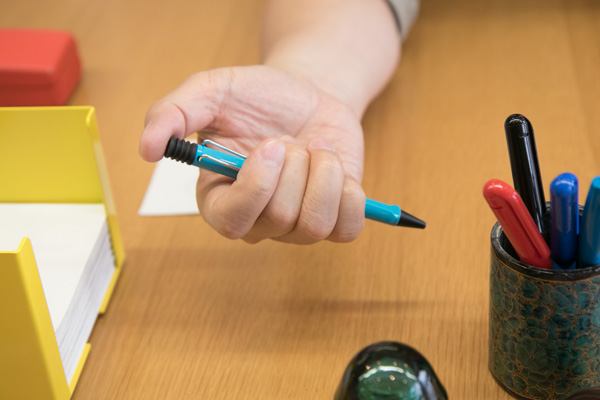
This one I also like. It’s Lamy’s ballpoint pen. This is also a true masterpiece. I think it’s awesome.

ph2-2

Sato:
Can’t forget to mention Pilot’s V cone. This has high usability.

ph2-2

Sato:
This isn’t something I bought but it’s my favorite memo rack. A while ago when I designed the library of Musashino Art University upon its rebuilding, I designed this memo rack for the library along with furniture like tables and chairs.
Hobonichi:
It’s neat. What’s it made of?
Sato:
It’s a simple design of painted iron panel. It’s not for sale since it’s an original design for the university but I asked the factory make one for me.
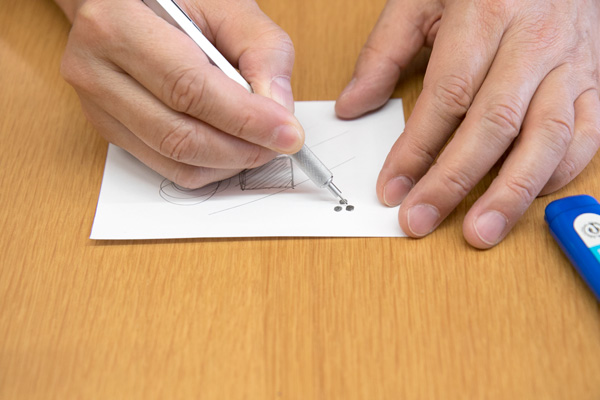
When I have pieces of waste paper, I cut it to this size and draw my ideas on them.
Hobonichi:
You draw your design ideas on these?
Sato:
With a small size like this, the work becomes lighthearted. A new piece of paper might make you nervous, but this paper is used and ready to be thrown away. I use it to give notes to my staff, or take it out to quickly sketch out an idea. For a logo mark, I would just draw a tiny sketch like this.

ph2-2

Hobonichi:
It’s surprisingly small.
Sato:
Logo marks need to be recognizable from a distance. So even at a miniscule size, it needs to have an identity. So, drawing big isn’t always the answer.
Hobonichi:
So your designs are birthed from these memos. Going through the items chosen by your point of view and intuition was an inspiring experience. Did you learn anything from taking a second to stop and re-examine the items you use?
Sato:
I guess it feels a bit revealing since a collection of items I’ve naturally chosen without a thought of showing others is bound to betray an undeniable character that I cannot hide.


A Look Inside Taku Sato’s Techo

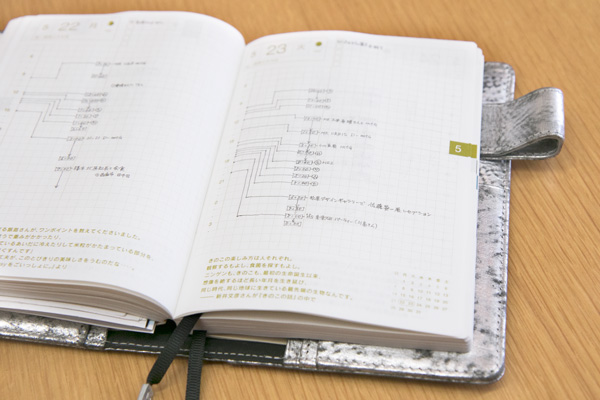
Taku uses Hobonichi Techo every year. We asked him to show us the contents of his techo from 2017.
ph2-2

Hobonichi:
We’ve interviewed you for the Hobonichi Techo Official Guidebook before when the unique way you enter your schedule made an impression on us.
Sato:
It’s like this. In the weekend, I write all of the schedule for the following week.
Hobonichi:
Wow! You draw a line for every hour.
Sato:
It follows a rule I made up for myself. I draw out a line from the 24-hour timeline and write the time on the left side of the secret vertical line, and the schedule on the right side. There’s also a rule to the interval at which the line bends, and how long a line should be drawn out horizontally.
Hobonichi:
The lines are placed apart nicely without overlapping.
Sato:
I use the grid to avoid the lines from overlapping. I sometimes notice how the lines I drew naturally make a graceful shape.

2017-10-12-Thu

Part 2

Save and Continue Shopping

*Please note, these exchange rate estimates based on Xurrency.com are intended as a guide only. The actual rate for your order may differ, as exchange rates change constantly, and international purchase costs vary by credit card.

Service temporarily unavailable