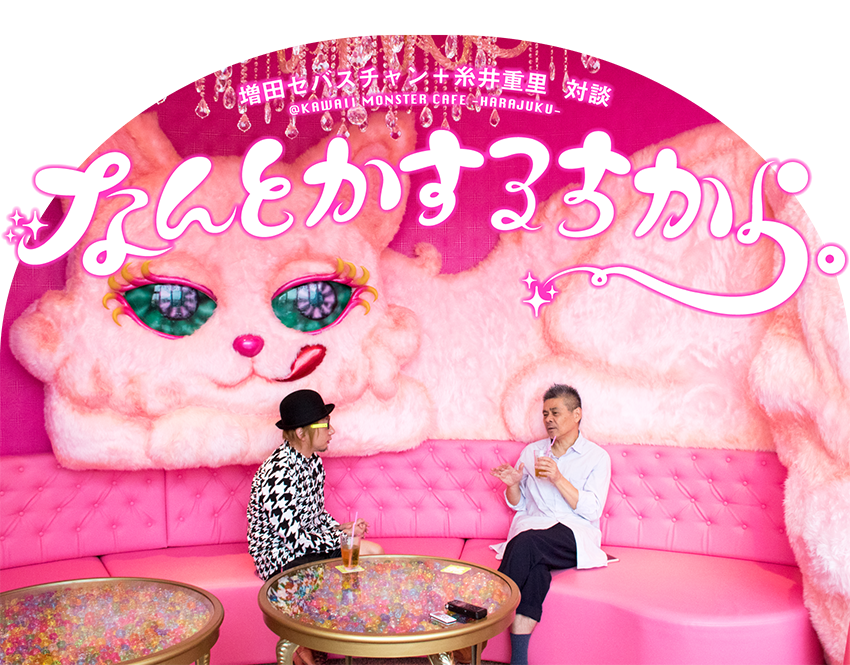
The Ability to Make It Work

Sebastian Masuda x Shigesato Itoi Interview
@KAWAII MONSTER CAFE -HARAJUKU-

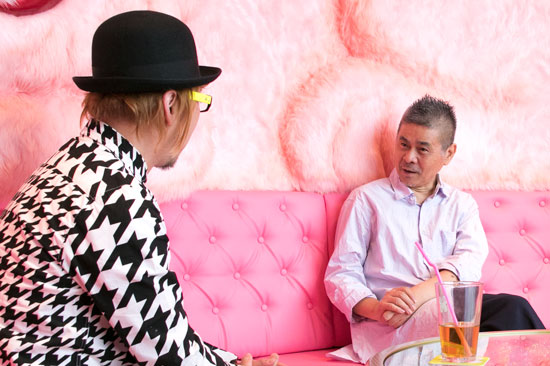
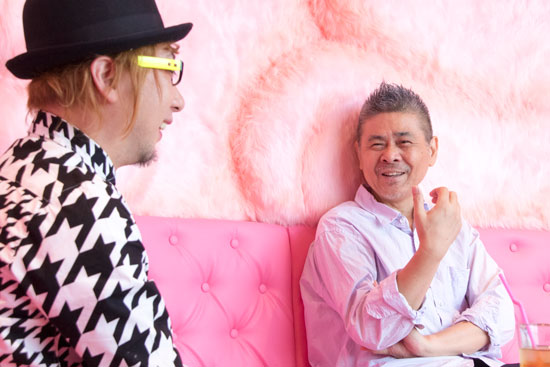
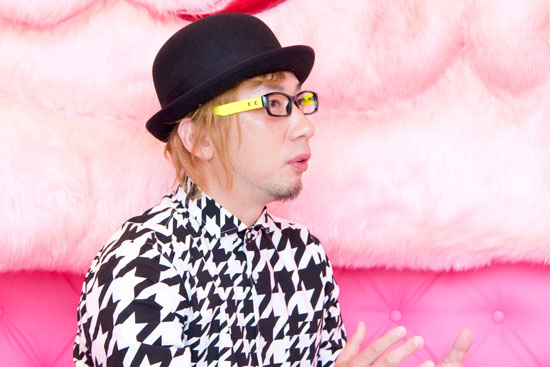
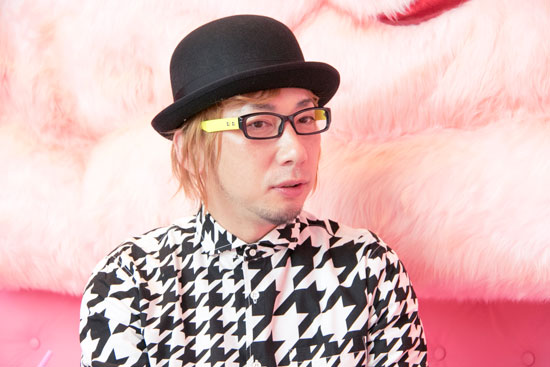
Art director Sebastian Masuda has created the Kawaii Monster Cafe, a place filled with mysteriously colorful food, bright interior decorations, and the same wild and cute style he developed for the early music videos of Kyary Pamyu Pamyu. Masuda’s unique style shines through the bright colors of his fascinating, unforgettable world. Shigesato Itoi sat down with Masuda after being intrigued by news of this new, exciting restaurant. At first glance, they seem like two men who have led very different lives, but their conversation uncovered a surprising commonality. It was wonderful to hear the way Masuda followed his passion to blaze a new trail.

About Sebastian Masuda
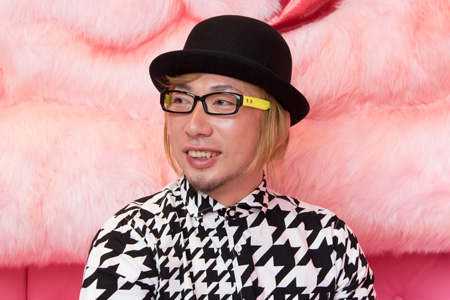
Sebastian Masuda is an art director/designer born 1970 who lead the “Kawaii” culture in Harajuku by pushing the boundaries with his designs in art, entertainment, and fashion. His main works include the 6%DOKIDOKI shop in Harajuku, art design for Kyary Pamyu Pamyu music video PONPONPON, production of theatrical restaurant Kawaii Monster Cafe in Harajuku, and more. He opened the art gallery Time After Time Capsule in 2016, hosted in Paris, London, San Francisco, and Los Angeles, and will host the gallery for the second time in New York in late October.
Sebastian Masuda Official Web Page

Part6

It just happened to be universal.

Itoi
It’s incredibly natural the way you just blend in with people around the world.
Masuda
I’ve been active overseas since I was in my 20’s, and people outside of Japan have always complimented me on how interesting my work is. But at the time, I couldn’t figure out what they were so impressed with. It wasn’t until much later that I realized it was my originality. People outside of Japan have a deep respect for originality.
Itoi
It’s true that there’s a lot of power behind having something that exists nowhere else, but it’s simultaneously frightening and easy to lose confidence.
Masuda
The one thing that gave me confidence that my work would resonate with overseas audiences is the music video for Kyary Pamyu Pamyu’s debut song PONPONPON. The YouTube video was a hit all over the world.

★PV入る https://youtu.be/yzC4hFK5P3g ★

Kyary Pamyu Pamyu – PONPONPON music video

Masuda
I actually used a ton of foreign snacks and toys when designing the set. I knew the music video was going to be released internationally on YouTube, so I wanted to use items that overseas audiences would recognize. I don’t think the video would have been as popular if it was restricted to Japanese snack icons like Kinoko no Yama or Koala’s March. I made the video for Kyary, of course, but I’d also calculated the design in a way that would allow me to communicate my message to young people overseas.
Itoi
Shigeru Miyamoto’s Nintendo games are all immediately accessible to overseas players. His Legend of Zelda RPGs didn’t rely heavily on their scripts, and players leveled up simply by improving at the controls. That’s key to making something universally appealing. Miyamoto’s games have earned him honorary medals from as far off as France and Spain; I can see that you’ve blazed a similar path to international audiences for yourself.
Masuda
That may be. It’s not that I’ve calculated my style to appeal to international audiences—it only just happened to be universal and gain the support of people outside of Japan.

Itoi
Oh, really.
Masuda
There were some people here that supported me, but in general, I could always sense that people in Japan were mocking my work. I’d often have people raise an eyebrow and imply that I was just some “Shinorer” groupie of Tomoe Shinohara. She was an important icon, as is Kyary Pamyu Pamyu, but my sole concern is creating things that only I can create. I poured everything I had into my work and was very serious about it, but Japanese people were very judgemental about it despite refusing to even look past the surface. International audiences, on the other hand, understood what I was going for.
Itoi
In other words, it was better to use a megaphone and broadcast your message to the good customers far away rather than trying to talk directly with all the places nearby that made you feel unwelcome.
Masuda
Something like that. It was right when social media was gaining popularity, so it was only natural that I made some connections that way.
Itoi
Come to think of it, I just remembered something that Miyamoto told me once. He said that games are incredibly popular when they interact with the senses of the player. If a game lacks that instinctual feedback, even the support of game critics wouldn’t get players to actually pick up the game.
Masuda
That’s just like how if you try to make products aimed at young people, there’s no way you’ll reach young people.
Itoi
Oh, really?

Masuda
Definitely.
Itoi
In that case, what kind of people do you have in mind when you’re creating your designs?
Masuda
I work with the thought that whoever can keep up with me is more than welcome to do so.
Itoi
Wow. (laughs) So you are using a megaphone to reach people that are far away.

Masuda
Things get really interesting when you manage to reach people from far away. The 6%DOKIDOKI shop went on a tour around the world in 2009, and that started from an e-mail from France. They said they’d like us to come because France didn’t have a culture like ours yet. But when we told them we didn’t have any money to plan anything or travel anywhere, they suggested we show up with a suitcase full of products to sell, and that would cover the travel expenses. But even then, we couldn’t speak any French, and we had nowhere to stay.
Itoi
But you still went, didn’t you?
Masuda
Yes, we just went on our own dime. I wanted to meet them after seeing how passionate they were. So we just kind of showed up, and they helped us find places to stay by introducing us to their university dorms and churches and what-not.
Itoi
Huh.
Masuda
And as soon as we told people we were going to Paris, people in London said “We’re only two hours away! Please come visit us too!” And then people in Berlin said, “Don’t forget us!” We had messages coming in from all different countries and figured we might as well do a world tour.
Itoi
Sounds like you guys won with your hands behind your back.

Masuda
I went out there with the girls from my shop, all on our own dime. We stuffed almost 50 pounds of merchandise into each of our suitcases and carried it all on us. We paid for our trip by selling our merchandise by day while all sleeping in a tiny crowded room at night.
Itoi
Yeah.
Masuda
But it didn’t end there. All the girls in Europe that supported us said “This is it, this is our culture,” and they started spreading the word. We never expected it to reach that point.
Itoi
If you’d sought out a sponsor and had them finance your trip, I don’t see how it could have possibly ended up with that same result.
Masuda
You’re probably right.
Itoi
It’s like both you and people overseas have things that you want to do, whether there’s a way to do it or not.
Masuda
Kyary basically had the same thing. I think all the adults around her were vehemently against my participating in the project when she was gearing up for her debut. I had no experience, no awards to my name, and I’ve never worked at an advertising agency before. It’s only natural for people to have doubts about leading a mainstream debut with a person no one’s ever heard of. But Kyary was kind enough to insist that I work with her because I’d created the worldview that she loved so much. Once we started working together, people would look at me like, “What’s this guy supposed to do?” But I’d had a great deal of jobs in the past where I worked with television stations and advertising agencies as a set carpenter. So I had all the necessary skills and knew I was capable of doing a good job. Over time, the rest of the crew came to trust my work, and the adults finally recognized what I was capable of.

Itoi
So you were a set carpenter, too. Sounds like a wonderful job.
Masuda
That’s just because I needed more money. I’d work at the 6%DOKIDOKI shop in Harajuku in the morning, and when I closed up at night, the only part-time jobs I was able to do after that were at the TV station. NHK was nearby the shop, so I helped build the sets for their annual historical drama series. Since I always put my utmost effort behind everything I do, they eventually started letting me actually design the sets. I developed a lot of skills back then, so I tell people I can build everything from the interior decorating of a studio apartment to a major concert set at Tokyo Dome.
Itoi
Wow!
Masuda
I’ve also participated in music video production at the lowest level, so I was generally familiar with how they work. So when we were filming PONPONPON, I put together a set that was twice as big as was actually necessary, and filled it with a semi-truck’s worth of snacks, toys, and accessories to help Kyary get pumped up during shooting. I made sure to go overboard with that because all the adults were just standing around thinking about how they could sell this new artist. Meanwhile, Kyary and I shared the same interests that had bonded us, and I was the only one that really knew what Kyary would like. I figured the staff would be pretty shocked if I took that vital point and really blew it out of the water.
Itoi
Yeah, I completely understand. That’s really crucial.

Masuda
At the time, I was taking hints from the book The Way of Manga by Fujiko Fujio. There’s an anecdote in there about how Osamu Tezuka had drawn out 1,000 pages for his manga Phoenix, and only ended up using 200 of them. I wanted to try out that method for the music video.
Itoi
Yeah, that’s a common thing people do. Sometimes it’s out of a sense of childish mischief, sometimes it’s a way for people to put up a fight and assert their dominance. I heard a lot about Eikichi Yawawa doing the same thing when he was young.

2016-12-06-Tue

BACK | Part 5