The Ability to Make It Work

Sebastian Masuda x Shigesato Itoi Interview
@KAWAII MONSTER CAFE -HARAJUKU-

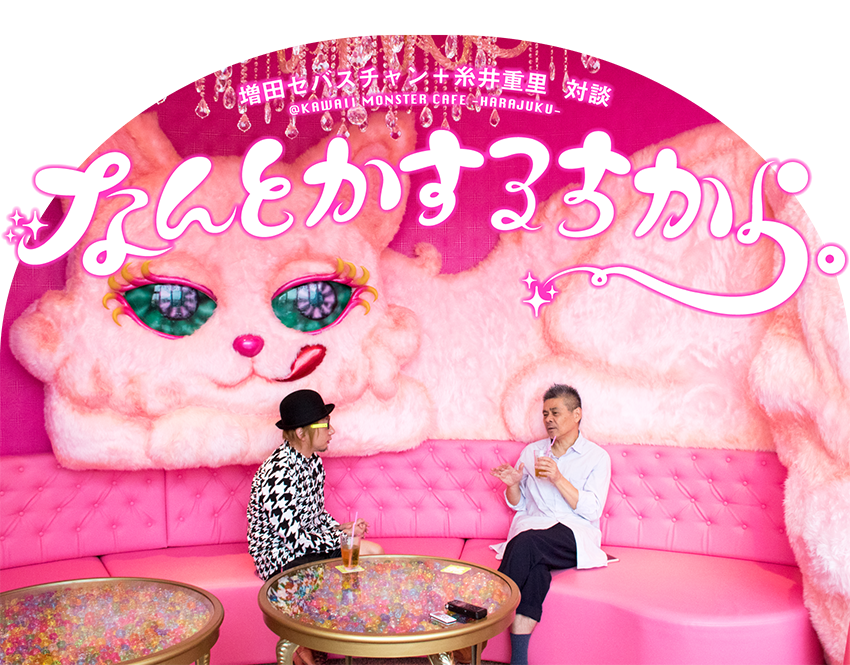
Art director Sebastian Masuda has created the Kawaii Monster Cafe, a place filled with mysteriously colorful food, bright interior decorations, and the same wild and cute style he developed for the early music videos of Kyary Pamyu Pamyu. Masuda’s unique style shines through the bright colors of his fascinating, unforgettable world. Shigesato Itoi sat down with Masuda after being intrigued by news of this new, exciting restaurant. At first glance, they seem like two men who have led very different lives, but their conversation uncovered a surprising commonality. It was wonderful to hear the way Masuda followed his passion to blaze a new trail.

About Sebastian Masuda
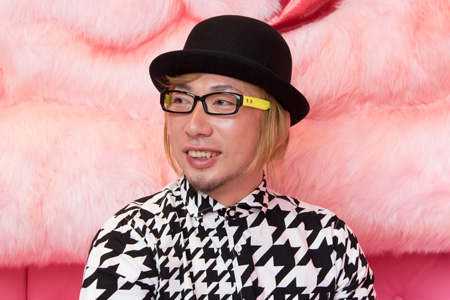
Sebastian Masuda is an art director/designer born 1970 who lead the “Kawaii” culture in Harajuku by pushing the boundaries with his designs in art, entertainment, and fashion. His main works include the 6%DOKIDOKI shop in Harajuku, art design for Kyary Pamyu Pamyu music video PONPONPON, production of theatrical restaurant Kawaii Monster Cafe in Harajuku, and more. He opened the art gallery Time After Time Capsule in 2016, hosted in Paris, London, San Francisco, and Los Angeles, and will host the gallery for the second time in New York in late October.

Sebastian Masuda Official Web Page

Part3

Mighty Harajuku.

Itoi
So you were in your twenties when you built up your own business, right?
Masuda
It’s actually taken twenty years for me to get where I am today. I opened the 6%DOKIDOKI shop in 1995, and that had moderate success as an original fashion brand. I felt more confident in my business skills and opened five shops around the country. We did made a lot of wholesale deals, too. But as I traveled around the region meeting with various CEOs, I realized they were on a major-league level entirely different from where I stood.
Itoi
The major-leaguers of the business world.

Masuda
Exactly. I thought I had business skills when I was running a shop in my twenties. But once I became active in the business world and met all those amazing people, I realized my business skills were limited to someone who runs a little stationery shop along a shopping street. I was acutely aware of the fact that I could never live up to them.
Itoi
Ah.
Masuda
So I pondered what it would take for me to match up to the major leaguers. I realized the only chance I had at making it big was as a creator, so I closed all my shops outside of Harajuku.
Itoi
The book only touched on that very briefly but that takes amazing courage.
Masuda
Well, I was 30 at the time, so I figured I better start now. If I were to invest in something new in my 40’s or 50’s, I wouldn’t be able to retire, so I knew it was now or never.
Itoi
So it wasn’t courage as much as it was a stipulation that made it easy to make a decision.
Masuda
Yeah. Either way, I wasn’t all that satisfied with my situation at the time. I wasn’t yet in a position to express my own words to the rest of the world, which I needed.
Itoi
I see.
Masuda
Plus, I wanted revenge.

Itoi
Revenge.
Masuda
Back when I didn’t have any influence or experience, when I was around twenty, people really tore me to pieces. It was the 80’s, so everyone treated American and European culture as superior. The trend was monochrome colors, and people were really into black. I was completely helpless at the time—people would immediately reject my work and call my use of colors childish. I was still bitter about that as I got older, so I wanted revenge on all the people who insulted me.
Itoi
You wanted them to accept your work the way it was.
Masuda
Yeah, and I believed that day would come. It ended up taking an incredibly long time, but things changed fairly suddenly with the debut of Kyary Pamyu Pamyu.
Itoi
Did you start working with her as just another one of your usual jobs?

Masuda
By 2010, I was also working independently as an art director in addition to running the store. I was also the director of a magazine when the editor asked me if I knew of any especially Harajuku-esque girls. I told him that Kyary was a really interesting kid.
Itoi
Was that right after she debuted?
Masuda
She was still in high school, so she hadn’t debuted yet. Kyary was originally a regular at the 6%DOKIDOKI shop. A really intense kid who stopped by once a week. I heard from the staff that we had a cute girl coming by every week, and she always wore a huge ribbon on her head.
Itoi
So her ribbon was there from the beginning.
Masuda
Yeah, she came with that. So I checked out her blog and saw what a Harajuku-esque, free-spirited girl she was. Honestly, most of the kids in Harajuku are the ones that stay cooped up in their rooms. But it was interesting seeing someone who exhibited such freedom around Harajuku, so we had her model for the magazine cover.
Itoi
I see.
Masuda
She became an overnight hit, and before long there were plans for her to put out her first record. That’s when her agency called me. They told me about her music debut and said, “She loves your work, so we’d like you to be her art director.”
Itoi
I see. So that’s where things went after 2011.
Masuda
That’s basically been my life since the disasters. Kyary debuted with her hit song PONPONPON and its music video July 2011, and that’s all led up to where I am today.
Itoi
I’m sure there was a big effect from the way the March 2011 tragedies happened so close to her debut.
Masuda
I think the Great East Japan Earthquake made everyone acutely aware of the possibility that tomorrow may never come. Before the earthquake, everywhere you went you’d hear the old hit song “Ashita ga Arusa” (There’s Always Tomorrow) that was making a comeback. There was this undertone that it was silly to work too hard. But once the earthquake hit, we all realized that there may not be a tomorrow after all.

Itoi
And everyone reflected on that.
Masuda
I believe so. But at the time, the kids in Harajuku were already doing whatever they wanted and weren’t concerned about tomorrow. So when the entire world turned their eyes to Japan to see what would happen to us, I think they found these kids in Harajuku still living true to their own styles. It was also right when YouTube was getting really popular, so the timing was ripe for Kyary Pamyu Pamyu’s music and imagery to turn her into an idol.
Itoi
Where were you on March 11th?
Masuda
I was in Harajuku at the time. The first earthquake hit, so I went to check on the shop. That’s when the second big quake hit, and the ground, the alleyways, everything was shaking. That night I saw on the news how many refugees there were, and I realized the extent of what was happening. I knew I had to do something about it, so I wanted to go to the disaster zone. But my staff stopped me the next day and said that without any background in emergency response, I would only get in the way. So I started to think what I could do from where I was.
Itoi
What you could do from Harajuku.
Masuda
Right. Harajuku completely shut down after that. All the tourists and the foreigners disappeared, and the convenience store shelves were stripped bare. I saw a lot of social media posts from people overseas worried that the tsunami had swept away all of Tokyo and took with it the pop culture they all loved so much. After all, Tohoku and Tokyo look very close when viewed on a world map.
Itoi
Yeah, Japan’s just so small.

Masuda
That’s when I thought it would be good for me to clear things up and let the world know that Tokyo was lucky to escape most of the damage, and that we were all doing well and our culture hadn’t gone anywhere. I wrote a blog in English and Japanese to show people how Harajuku was doing, and people started following the blog and offering moral support.
Itoi
Yeah.
Masuda
This was my Mighty Harajuku project. I made a bunch of pins that said MIGHTY HARAJUKU! on them and passed them out around town to shops and passerbys. There’s a lot of media snapshots taken in Harajuku, so I thought it would be good to have these buttons show up to spread the word that Japan would be okay. So that’s one of the ways I promoted Harajuku. It was actually the first area in Tokyo to see the return of foreign tourists, and I heard later on that the Mighty Harajuku project played a part in that.
Itoi
That’s also when a florist across the street from our office was handing out yellow daisies on the street. They said that now was the time to have bright flowers around. So they were handing out flowers while you were handing out pins.
Masuda
Yeah.
Itoi
Come to think of it, I also made a point to write every day, “Tokyo is doing well.” Sure, there were people in Tokyo that were freaking out, but I wrote it every day with the thought, “Sure, things are hard, but can’t you see that here in Tokyo we’re the ones in a position to be helping out?” But in the end, people just got very angry with me about that.
Masuda
I, too, got a lot of e-mails telling me I had no tact. But the project made waves all over the world when a girl in Australia uploaded a picture of her holding a sign that said “We vow to ‘MIGHTY HARAJUKU!’ Stay genki!” So people in Los Angeles and cities all over the world followed suit and started uploading pictures of their support on social media. That’s when I first realized how incredible social media could be.

Itoi
I only used social media when I had to, and I didn’t really give much thought to it in that regard. But the energy surging through social media around that time practically had it rattling. It was amazing.
Masuda
It really was.

2016-12-06-Tue

BACK | Part 2