

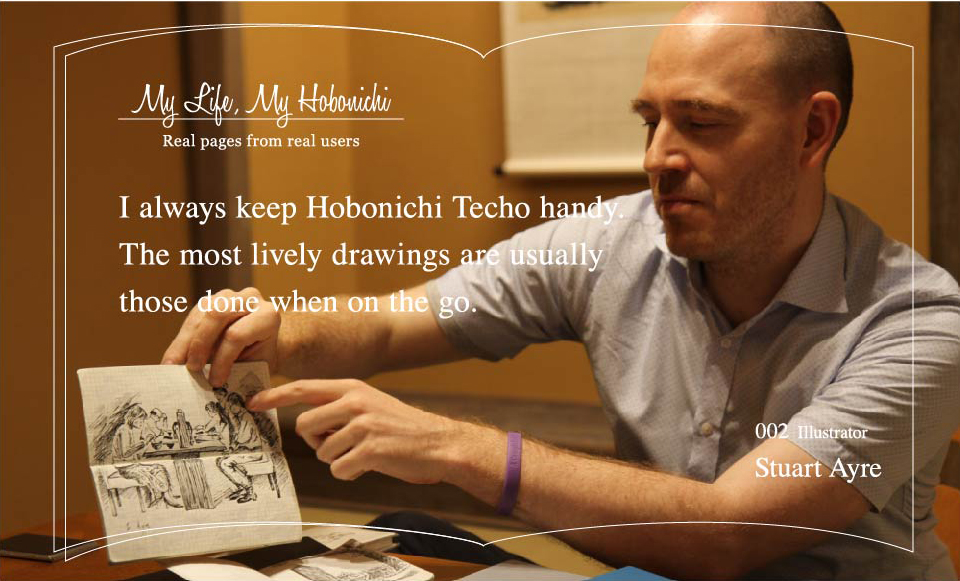
A legal translator whose other passion is drawing, Stuart Ayre never tires of sketching Tokyo. From its scramble intersections to characterful portraits of its people, he spends his daily commute, lunch breaks, and weekends trying to record the city on paper. A native of the U.K., Stuart studied fine art at Oxford University and holds the jun-sandan (pre-third) rank in shodo, or Japanese calligraphy. He is the illustrator of A Walk in Japan, a 2015 translation of a 1910 travelogue written by a German who traveled in late Meiji-era Japan.
- Hobonichi:
- You seem so at home in Japan. Have you ever thought that in a former life you might have been here?
- Stuart:
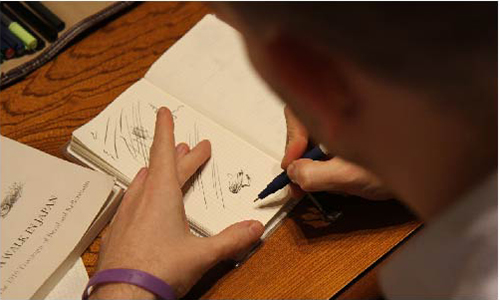
- I’ve been visually attracted to Japan since I was a boy. Its urban landscapes are a visual feast, and the way Japanese artists have drawn Japan is bewitching. Hasui Kawase’s woodblock prints and Yamaguchi Akira’s paintings are some of my favorites. I also adore shodo. It helps you develop both a dexterous hand and a hawk’s eye for examining line. It’s improved my drawing enormously.
- Hobonichi:
- You’ve lived in Japan for twelve years, three of those in Tokyo. Does it still feel fresh to you?
- Stuart:
- Really fresh! Like a fruit feast. I grew up in a market town in north England, and I’ve not lived for much time in a city of millions. I’ve lived in Nagoya and Sapporo, but unlike them Tokyo feels like many cities jammed together. In much of Tokyo, you can simultaneously peek into different lives. In the space of a minute, you might see a suited lawyer with a suitcase heading abroad, a celebrity model, a soba restaurant’s deliveryman balancing a tray stacked with lunches, a sleeping taxi driver, a tourist freshly arrived from overseas . . . Tokyo is conducive to drawing. Imagine somewhere that you want to explore — Easter Island, the Lascaux Caves in France, Madagascar with its Baobab trees. If you went there, you’d likely feel more inclined to take photos or draw it. Tokyo feels like that to me.
- Hobonichi:
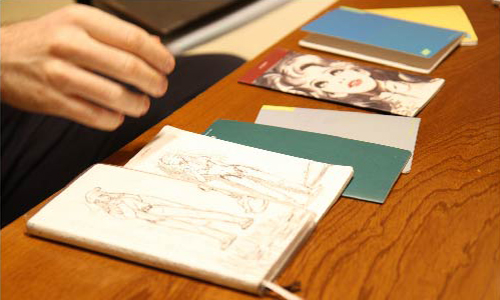
- We see you’re using both the Original and Weeks sizes of the Hobonichi Techo!
- Stuart:
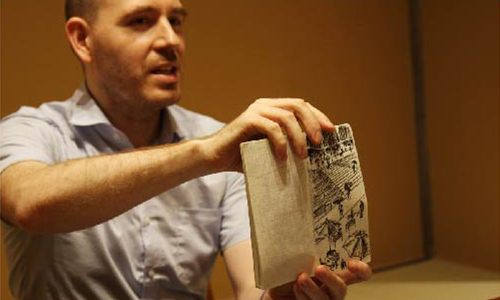
- If you’re ready to start drawing at a moment’s notice, you’ll be more likely to draw. These techo notebooks help me do that, because they’re small, light, and bendy. I can whip one out from my pocket or bag and start drawing within ten seconds. It’s like kaitenzushi: there’s no barrier between you and the dishes, you just take them and eat them. If you’re interested in drawing, I recommend carrying a notebook like one of these flexible techo.
- Stuart:
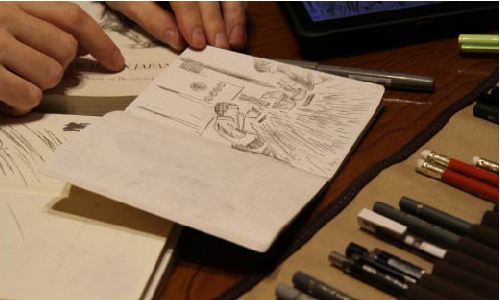
- The long, narrow orientation of the wallet-sized techo is perfect for drawing various people in the same space going about their lives. Take a crossroads scene like this. There might be, say, 200 people there — workers in offices, people having a coffee, taxi drivers. When I draw in Tokyo, I want to put as many of these different worlds on a piece of paper as I can. The orientation of this techo is good for that. I also like the gridded paper. The squares can be used for measuring — a person might be two squares tall, a road might be six squares wide, for example.
- Hobonichi:
- Do you separate your techos by theme?
- Stuart:
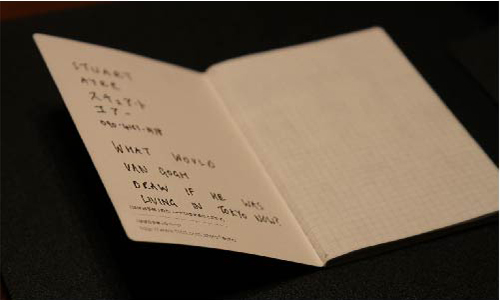
- Not too much. It’s good to not have too many rules, because you’d wind up not drawing. I use a theme sometimes. For example, in the beginning of this one I wrote “What would Van Gogh draw if he was living in Tokyo now?”
- Stuart:
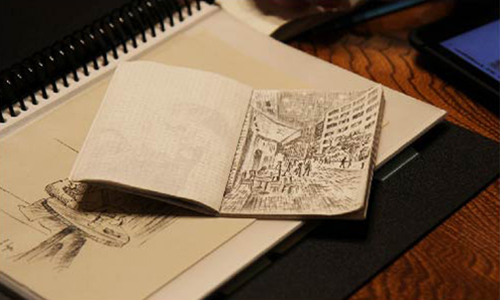
- Van Gogh adored Japan. He’d have come here in a flash if he’d been able to. He drew himself as a Japanese person and thought he’d discovered Japan near Arles in the south of France. Do you know his Café Terrace at Night? A couple of months back, I was seeing off a friend at Ebisu Station late at night and saw a café terrace that looked just like it. The café in Van Gogh’s painting used to stay open all night long, and this one in Ebisu was still buzzing past 11 p.m. I just had to try and draw it with Van Gogh’s hand — his particular way of mark making and stippling. I like to think that he’d be pleased someone actually in Japan was borrowing his style to draw.
- Hobonichi:
- And you’ve got such a collection of writing tools! Any favorites?
- Stuart:
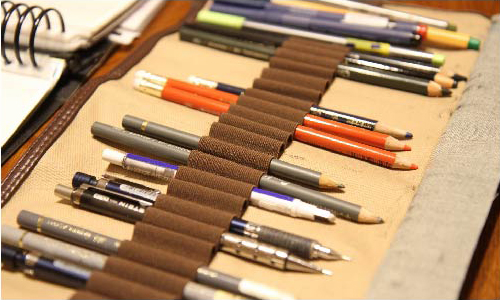
- I love these water-based Pilot drawing pens. Some pen tips snap when you put pressure on them, but these don’t. You can adjust the line thickness easily as well. And I like Pentel’s Brush-Touch Felt Tip Pen.
- Stuart:
- In general I find brush-style fude pens difficult to use. But I like this one, because it’s more rigid, which gives greater control. Drawing and writing with it isn’t difficult, even if you don’t use a fude pen much. You can draw in gray as well.
- Hobonichi:
- How many pens do you go through in a month or year?
- Stuart:
- Oh, I’ve got . . . My apartment’s like a stationery store! I’ve got hundreds.
- Hobonichi:
- Besides drawing, do you use your techo for scheduling and work-related things, too?
- Stuart:
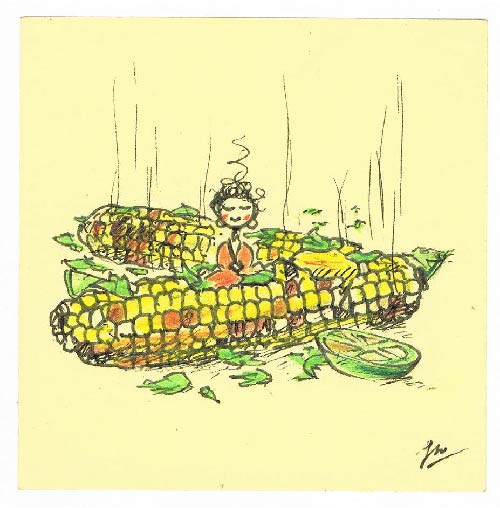
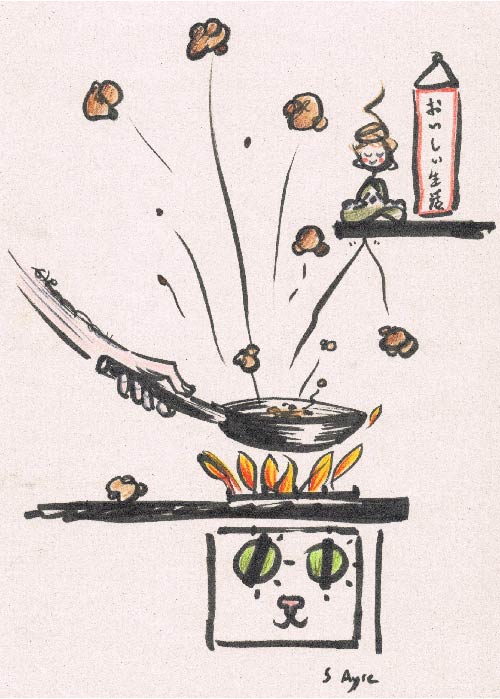
- I use a computer for work things. These notebooks are for my own fun. Here’s a series I started to draw in my break times at work. I imagine a place I’d like to be or some food I’d like to be eating, and this little Buddha takes me there. For example, when I drew this one, I wanted to eat a Mexican corn-on-the-cob with cheese and lime.
- Stuart:
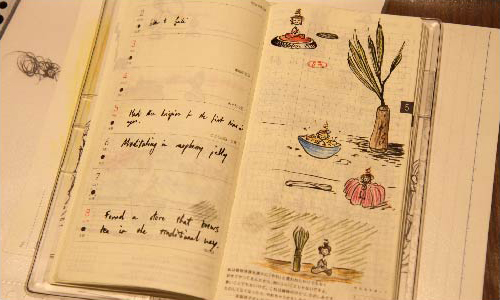
- Another time I imagined I was set in raspberry jelly . . . funny what your mind throws out when you’re at work!
- Hobonichi:
- These are adorable!
- Stuart:
- Thank you. I’ve been drawing these for about two-and-a-half years now. The ones drawn in the techo are my first drafts. I usually do a neater one later on. People seem to like them.
- Hobonichi:
- Why the meditating Buddha?
- Stuart:
- Before Nagoya I lived in Okazaki, a town that’s dotted with temples. I sat zazen once a week in a small wooden temple surrounded by rice paddies. I think it originates from that experience and the calm monk who used to meditate with me. Also, they’re drawn with curved lines and no straight lines, which is relaxing.
- Hobonichi:
- So when things are tough at work, this character meditates on your behalf?
- Stuart:
- Exactly! There’s also a connection with Enku, the Japanese Buddhist monk who carved tens of thousands of wooden statues, each of which was slightly different. I imagine that carving them relaxed him and that giving them away pleased him. I enjoy drawing this character for people as well.
- Hobonichi:
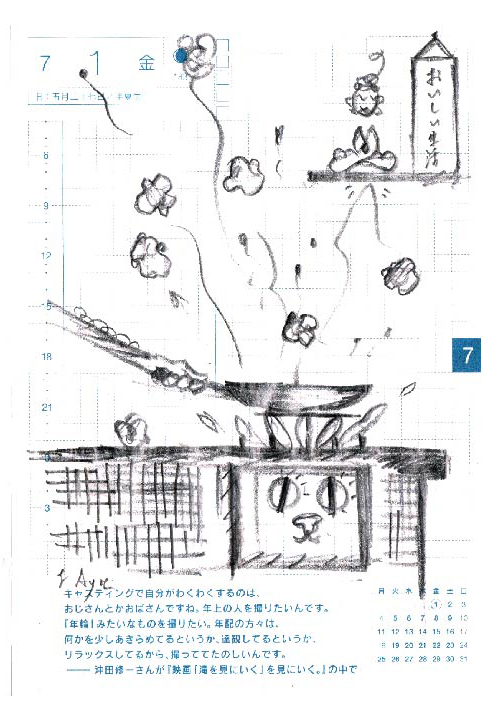
- Each one ends on a positive note. You start with a stressor — for example, “Lots of paperwork.” But you wind up with something happy, like popcorn or green trees at Hibiya Park. It’s like this character is helping you get through.
- Stuart:
- Oh definitely! I feel calm after doing one of these. Drawing them is akin to brewing a cup of tea or solving a crossword puzzle. It’s soothing because you focus on it for a short amount of time — perhaps five to ten minutes. Anyone can do this for themselves in the midst of a busy day.
A few of Stuart’s favorite haunts around town for people-watching and sketching include Starbucks at the Shibuya scramble crossing, Le Café Doutor in Ginza, Seibu Shinjuku Ekimae McDonald’s in Shinjuku, and the Tokyo Metro Chiyoda Line. But you can find him online anytime in the following places:
stuart-ayre.com/archive
facebook.com/StuartAyreIllustrator
instagram.com/stuartcayre
Interview: Susan Rogers Chikuba