

日本語のわからない海外の人が、
翻訳ツールを使って
ほぼ日を毎日読んでいるとしたら?
世界のどこかにひとりくらいは、
そんな人もいるのかなぁと思っていたら、
なんといました! ほんとうにいたんです!
彼女の名前は、マデリン。
オーストラリアに住む16歳の女の子からでした。
自動翻訳の精度に満足できず、
「公式の英訳記事をもっと出してもらえませんか?」
というメールをほぼ日に送ってきたのです。
日本語のわからない彼女が、
どうしてそんなにほぼ日を読むようになったのか、
ちょっと気になりませんか?
メールでのやりとりを通して、
彼女が読んでいる「HOBONICHI」のこと、
もっとくわしく教えてもらうことにしました。
それでは、マデリン、よろしくね。
Madeleine(マデリン)
オーストラリア在住。
現在は17歳になり、
高校の最終学年を迎えました。
地元のスピーチ大会では、
3度の優勝経験を持つそうです。
好きな科目は「数学」。
好きなゲームは「MOTHER」。
翻訳ツールをつかいながら、
いまも毎日ほぼ日を読んでいるそうです。
※プロフィールは随時更新予定です。

- さあ、おまたせしました!
前回まではプロローグでしたので、
正式にはこれが連載1本目になります。 - ‥‥と、その前にちょっとだけ補足。
- 第2回のときにも紹介しましたが、
マデリンとのメールのやりとりは、
ほぼ日の西本が担当しています。
そんな西本がこの原稿をもらったのは、
「ほぼ日手帳2026」販売直前の8月でした。 - この時期、西本は手帳の仕事に追われ、
彼女への返事が遅れてしまったことを、
ひとつ前のメールでかなり気にしていました。
連載1本目のメールは、
そんな西本への労いからはじまります。
マデリン、ほんとにいい子だなぁ。 - メールの終わりには、
マデリンから届いた写真もありますので、
ぜひ最後までおたのしみください。
Dear Tsubasa,
I was very moved at reading your comment on my speech ― once again, your considered and thoughtful words truly warmed my heart.
Just like you at Hobonichi, this period of my life has been very much bustling. Over the next two months, I’m studying for my final exams, as well as keeping up with work and other commitments. At the same time, I’m going through the process of running for school captain (like a class president, but for the whole school). It’s quite like you described: busy, but exciting and energising every day. I’m satisfied for us to continue our exchanges at a pace that suits each of our needs, so there is no need to worry about delays in replies.
I don’t know exactly how Australia is perceived in Japan, but I can guess that my town conforms to maybe the least stereotypes out of anywhere in the country. I live in a rural area, in a town of 25,000 people. It’s at a high altitude (by Australian standards), is hours from the beach (although in Summer, I swear the whole town is at the pool), and in Winter (which is right now!) it’s absolutely freezing (it even snowed today for the first time in years!).
Whilst a part of me longs to return to the city (I was born in Brisbane), I am actually very grateful to have grown up in this miserable town. It’s funny: in some ways, communities like mine are very close-knit and sociable (for example, my boss is the cousin of my friend, who is the neighbour of my English teacher), but in other ways, there’s a comforting loneliness that emerges from the ‘wide open spaces’ in these parts of the country.
I’m in my second last year of high school, so as I mentioned earlier, things are starting to get intense. Sometimes it’s hard to get out of bed in the morning, knowing that I have a seemingly endless load of questions to study. But, I have to be honest: I’m a bit of a nerd, and I love school! I love seeing my friends, and I love the sense of purpose and achievement I get from working hard in my classes.
Out of every class though, Maths is the one that I adore most. Maybe that’s strange, considering my love of writing, but it’s true! The satisfaction that comes from getting a really hard question right, or explaining a concept to someone in a way that just clicks is unmatched in any other subject. In every field, Maths has applications ― it’s like the language of the universe. In fact, it’s probably the only subject that I’d still be able to make sense of if I went to a Japanese school ― isn’t that fascinating?
Maybe it’s because of my love of Maths that I have become so obsessed with numbers. Like I said in one of my speeches, in most parts of my life, I’m always chasing numbers. How many hours I study, how much money I earn from my job, how high my marks are, what place I rank in competitions ― everything important seems to be given a numerical value.
So I was both shocked and impressed to read the other day that,
At Hobonichi, there are basically “no goals” for either the team or individuals. There are no numerical goals, no qualitative goals, nothing like that.
It was from the conversation with Shinpei Inoue. Though it was long, the ideas covered were so intriguing that I couldn’t help but read through to the end. Inoue’s philosophy that we should do things we find interesting, without worrying about profits or aims, contained such insight. However, I could understand that many people would struggle to implement it, especially when they have responsibilities and constraints.
It’s a methodology that is foreign to my own life, too. Although corporate culture in Australia is nowhere near as intense as it is in Japan, as a student, I still resonated with what was described. Schools are not a place where you are given much freedom to follow what is interesting, or ‘grade by your own scale’. Instead, our teachers and parents are constantly telling us that we need to be ‘working hard towards our goals’. Ah, this relates to some of the themes I covered in my speeches.
However, when I considered it, I realised that having ‘no goals’ is a more natural way for an entity to be. ‘Goals’ implies ‘ending’. So then, by focussing on ‘goals’, what we are really focussing on is ‘death’. Maybe that’s harsh, but for me, it’s true. In a few months time, I’ll have finished high school Maths, as I began the senior course for that subject a year early. Every day, I’m working hard to achieve my goal of getting a good mark. But as I draw nearer to that goal, an acute awareness has overcome me: once I achieve it, it will be over. The thought leaks a little sadness into my heart.
Hence, I found the premise of this project a little strange, but refreshing. Rather than ‘counting backwards from the future’, like I do with all my other passions, we’re starting from right where we are, and letting things grow on their own. I’m no longer frightened of an ending or rushing for deadlines: I’m just allowing myself to ‘live’ and enjoy each precious exchange with you.
Ultimately, everything is about people. By focussing too much on our goals, we forget why we wanted to achieve them in the first place. Earlier, I stated many reasons that I loved Maths, but I missed the most important one: my Maths teacher. He has always been there for me, and inspires me to believe in myself when no one else can. Most of all, I set high goals for my results because I want to make him proud.
In a similar way, this project is essentially just a connection between two people. Although it is to be published for anyone to read (and by the way, feel free to use any excerpts from our communication as you see fit), the heart of it is that I am writing to you.
I hope you are not working yourself too hard. It’s important to ‘enjoy the scenery’, too.
Your emails always make my day, so when the next one arrives, I’ll read it with excitement.
Love from Madeleine
ツバサさんへ
私のスピーチへのコメントを読んで、
とても感動しました。
ツバサさんの思慮深く、心のこもった言葉に、
またしても心が温まりました。
ほぼ日でのツバサさんと同じように、
私のこの時期の生活も、
とても慌ただしいものになっています。
これから2ヶ月間、私は期末試験の勉強をして、
同時にお手伝いや他の責任も果たさなければなりません。
また、スクールキャプテン
(学校全体の生徒会長のようなものです)に
立候補するプロセスも進めています。
まさにツバサさんがおっしゃっていた通り、
忙しいけれど、刺激的でエネルギーに満ちた毎日です。
私たちがお互いのニーズに合ったペースで
やりとりをつづけることに満足しているので、
返信の遅れについて心配する必要はありません。
オーストラリアが日本でどのように思われているか、
正確にはわかりませんが、
私の町はおそらくこの国で、
最もステレオタイプから
かけ離れているのではないかと思います。
私は人口2万5千人くらいの
小さな町に住んでいます。
そこは(オーストラリアの基準では)標高が高く、
ビーチからは何時間も離れていて
(夏には、町中の人がプールに
いるんじゃないかと思うほどですが)、
冬(まさに今です!)は凍えるほど寒いです
(今日は数年ぶりに雪まで降りました!)。
都会(私はブリスベン生まれです)に
戻りたいと切望する自分もいますが、
この侘しい町で育ったことに、
じつはとても感謝しています。
おもしろいことに、私のようなコミュニティは、
ある意味では非常に密接で
(例えば、私の上司は私の友人のいとこで、
その友人は私の英語の先生の隣人で‥‥みたいな)
社交的でありながら、
別の意味では、この国のこうした地域の
「広々とした空間」から生まれる、
心地よい孤独感があるのです。
私は高校の最終学年の1年前なので、
だんだんと大変になってきました。
勉強すべき問題が果てしなくあると思うと、
朝、ベッドから出るのが辛いこともあります。
でも、正直に言うと、
私、ちょっとした「ナード(勉強好きな子)」で、
学校が大好きなんです!
友達に会うのも好きですし、
授業で一所懸命がんばることで得られる
目的意識や達成感も大好きです。
すべての授業の中で、
私がいちばん夢中なのは「数学」です。
文章を書くのが好きなことを思うと、
不思議に思われるかもしれませんが、本当なんです!
難しい問題が解けたときの満足感や、
誰かにコンセプトを説明して、
それが相手に「ストンと腑に落ちた」ときの満足感は、
他のどの教科にも代えがたいものがあります。
数学はあらゆる分野に応用できます。
まるで宇宙の言語のようです。
実際、もし私が日本の学校に行ったとしても、
意味がわかるであろう唯一の教科かもしれません。
それって、とても興味深いことだと思いませんか?
私がこれほど数字に執着するようになったのは、
数学が好きだからなのかもしれません。
スピーチのひとつで言ったように、
私は人生のほとんどの場面で、
いつも数字を追いかけています。
何時間勉強するか、仕事でいくら稼ぐか、
点数はどれくらい高いか、大会で何位になるか。
重要なことはすべて、
数値で評価されるように思えます。
だから先日、こんな文章を読んで、
ショックを受けると同時に感銘を受けました。
ーーーーーーーーー
ほぼ日では、チームにも個人にも、
基本的には『目標』がありません。
数値目標も、定性的な目標も、
そういうものはいっさいないんです。
ーーーーーーーーー
それは、ほぼ日で掲載されていた
井上慎平さんとの対談からの言葉でした。
長い記事でしたが、
扱われている考えが非常に興味深かったので、
最後まで読まずにはいられませんでした。
利益や目的を気にせず、
おもしろいと思うことをすべきだという
井上さんの哲学には、
深い洞察が含まれていました。
同時に、多くの人々が、
とくに責任や制約がある中で、
それを実行するのは苦労するだろうことも
理解できました。
それは、私の人生とも無縁の方法論です。
オーストラリアの企業文化は
日本のそれほど厳しくはありませんが、
ひとりの学生として、
私は書かれていたことに共感しました。
学校は、おもしろいことを追求したり、
「自分自身の物差しで評価」する自由が
与えられる場所ではありません。
むしろ、先生や親は絶えず私たちに、
目標に向かって努力する必要があると
言い聞かせます。
ああ、これは私のスピーチで取り上げた
テーマのいくつかと関連していますね。
しかし、考えてみると、
「目標がない」ことのほうが、
存在としてより自然なあり方だと気づきました。
「ゴール」は「終わり」を意味します。
だとしたら、「ゴール」に焦点を合わせることで、
私たちが本当に焦点を合わせているのは、
「死」なのです。
厳しい言い方かもしれませんが、
私にとっては、それが真実です。
私は上級コースを1年早くはじめたので、
数ヶ月後には高校の数学を終えることになります。
毎日、良い点を取るという目標を達成するために
一所懸命努力しています。
でも、その目標に近づくにつれて、
鋭い気づきが私を捉えました。
一度それを達成してしまったら、
それは終わってしまうのだ、と。
そう思うと、心にほんの少しの悲しみが
漏れ出してきます。
それゆえ、この連載の前提を、
私は少し不思議に思いつつも、新鮮に感じました。
他のすべての情熱に対してやっているように
「未来から逆算する」のではなく、
私たちがいまいる場所からはじめて、
物事が自ずと育っていくのに任せています。
私はもう、終わりを恐れたり、
締め切りに焦ったりしていません。
ただ、自分自身が「生きる」ことを許し、
あなたとのひとつひとつの
貴重なやり取りを楽しんでいます。
結局のところ、すべては人なのです。
自分の目標に集中しすぎると、
そもそもなぜそれを達成したかったのかを
忘れてしまいます。
先ほど、私が数学を好きな理由を
たくさん挙げましたが、
最も重要なことを見逃していました。
それは、私の数学の先生です。
彼はいつも私のためにそこにいてくれて、
誰も信じてくれないときでも、
私に自分を信じるよう励ましてくれます。
何よりも、私が結果に対して高い目標を設定するのは、
彼に誇りに思ってもらいたいからです。
同じように、このほぼ日での連載も、
本質的にはふたりの人間のつながりにすぎません。
誰でも読めるように公開されるとは言え、
その核心は、私が「あなた」に宛てて書いている、
ということです。
あまり無理をしすぎていないといいのですが。
「景色を楽しむ」ことも大切ですよ。
あなたのメールは、
いつも私の一日を素敵にしてくれるので。
次が届くのを、わくわくしながら待っています。
Love from マデリン
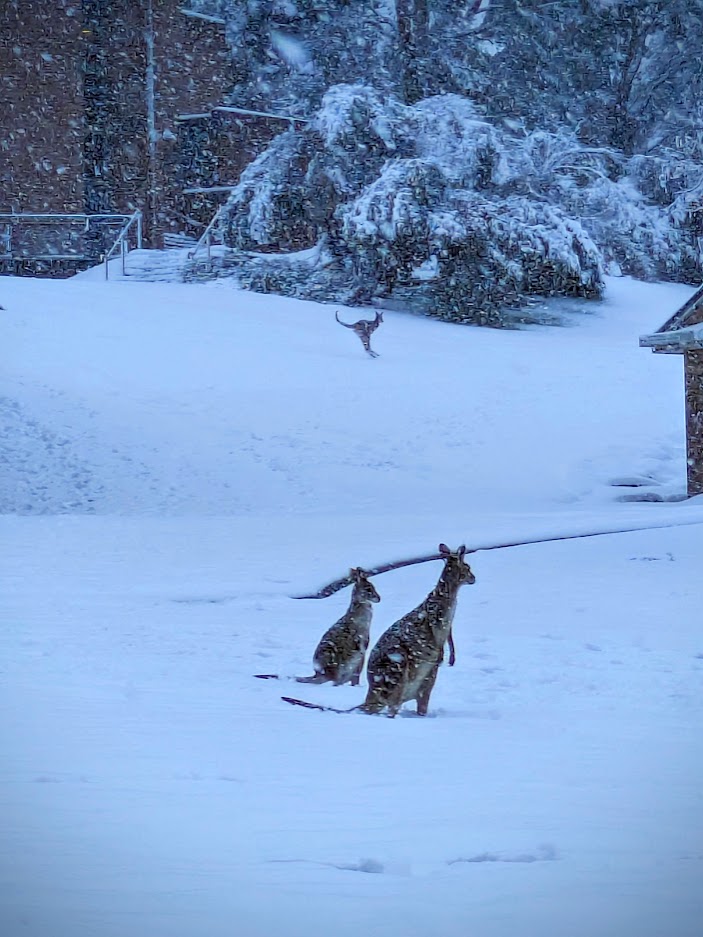 ▲I took this photo today. It almost never snows like this! It was amazing.
- なんとなんと、
メールに添付されていたのは、
大雪の日の写真でした!
そっか、オーストラリアは南半球だから、
日本とは季節が真逆なんですね。
写っているのは野生のカンガルー? - マデリンの連載はこんな感じで、
月に一度か二度ほど更新していく予定です。
これからもあたたかく見守っていてください。
よかったら感想もまってます! - それでは次回の更新も、おたのしみに。

(次回につづきます)
2025-10-06-MON
