Hobonichi Techo NEWS
Techo team members will be talking about sales information,
their recommended stationery, usage examples, and more.
[Great things about covers and stationery]
Cherry Created with 6 Colors of Thread

Hi, I'm Hirano from Techo Team.
The weather in Tokyo is still all over the place, but it’s starting to feel more like spring. Sometimes, it suddenly goes back to winter, which can really throw off your body, but that just gives you more to write about in your journal.
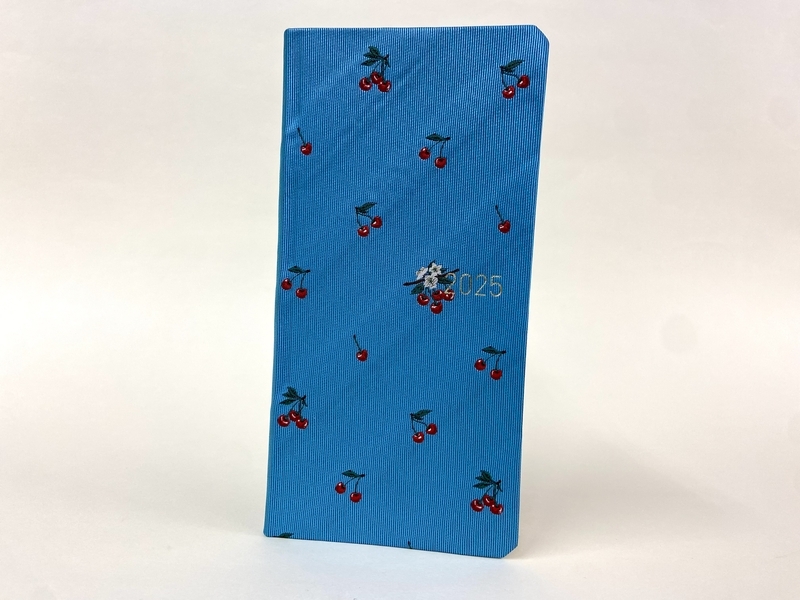
This series is where crew from the Hobonichi Techo team share the great things of covers and stationery. Today, I'm introducing a Weeks that’s perfect for spring ー ”Cherry.”
The Bow & Tie series, made with woven fabric used for neckties, has been a staple for over 10 years. The design changes every year, and this year's ”Cherry” has a watercolor-like feel to it.
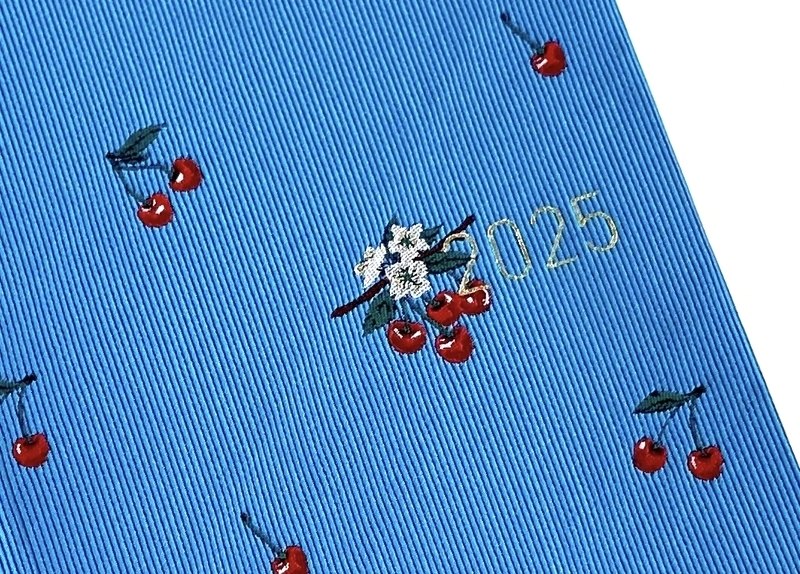
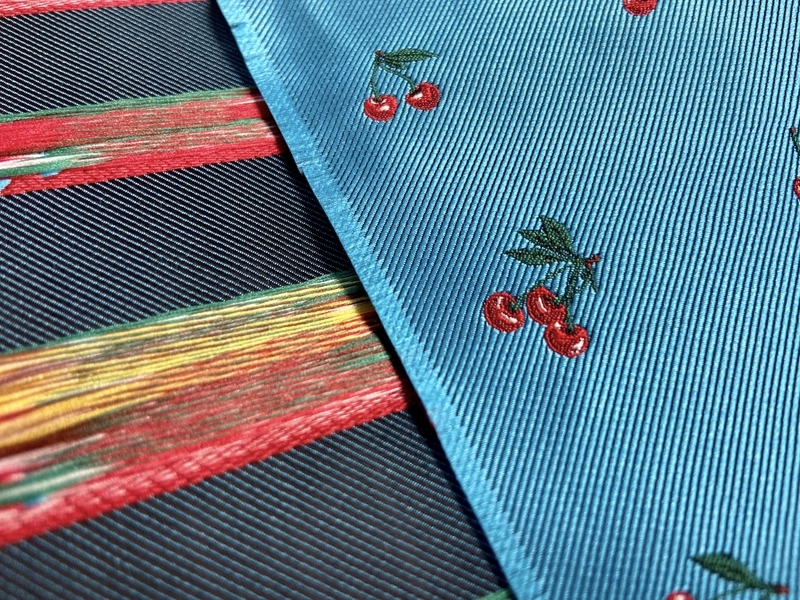
Let's take a closer look. Zooming in…
The details are just stunning. I've been in charge of writing about the Bow & Tie series every year, and when I saw this fabric, I thought, ”Wow, they’ve really taken it to the next level!” The cherries have the perfect shape, complete with shading, and even the leaves and flowers are carefully detailed. The fabric’s base is light blue, and the other threads used are green, red, dark red, white, brown, and yellow. Just six colors, yet the level of detail is incredible.
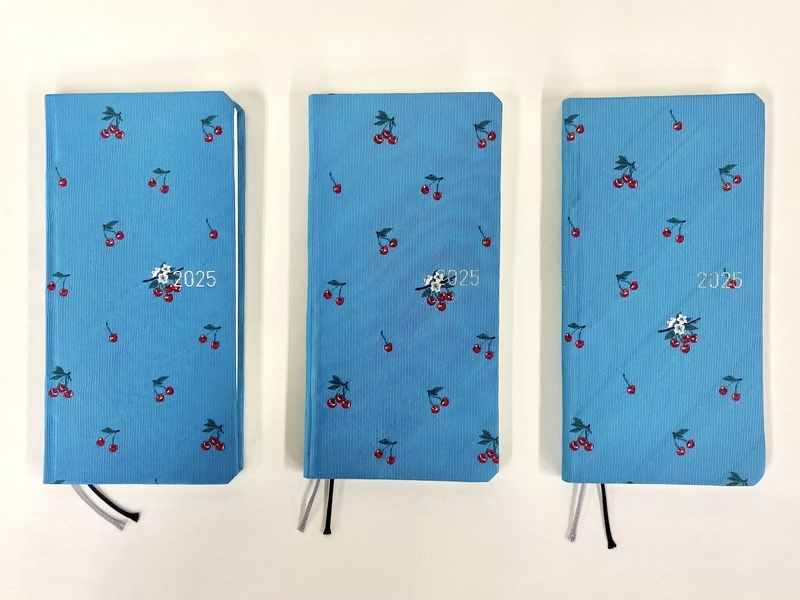
Since this series is made by cutting from a large woven fabric, every single cover has a different pattern. Let’s line up three of them for comparison.
From a distance, they may look the same, but if you take a closer look, you’ll see the differences. When you get yours, be sure to check it out. Some covers have cherries overlapping the ”2025” on the front, while others might have cherry blossoms on the spine. No two are exactly alike.
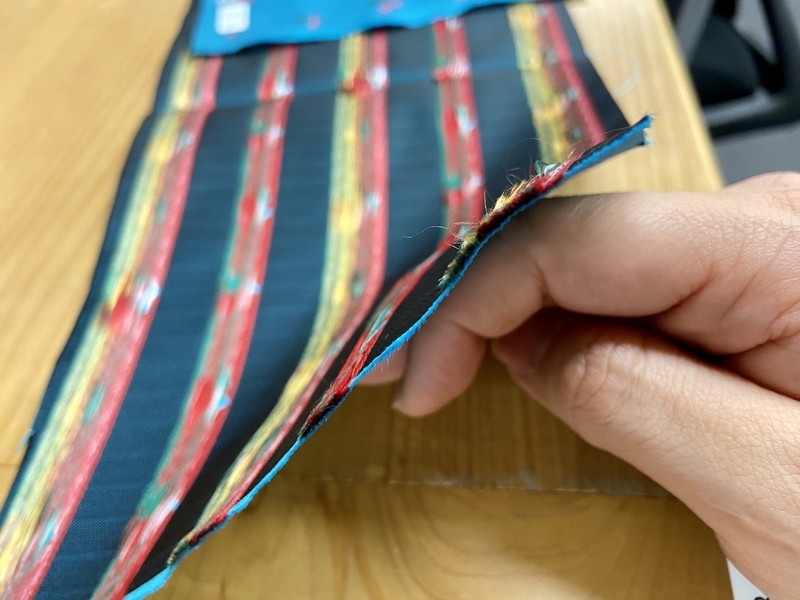
Now, let’s take a look at how this fabric is made ー here’s the back side.
Look at all those colorful threads. It’s like a river flowing across the entire fabric, not just where the cherries are. Even if you only saw the back, you wouldn’t be able to guess what the front looks like. Even if you get up close, turn it sideways, touch the threads, or even try pulling on them, it’s hard to figure out how these threads come together to form the cherry pattern. But then, I thought about it in terms of swimming, and it suddenly made sense.
Swimming? What does that have to do with anything?
Okay, hear me out.
Imagine six swimmers in the same lane of a pool. Got the image? Now, all of them are underwater. Each swimmer is wearing a different colored cap:
1 = Green, 2 = Red, 3 = Dark Red, 4 = White, 5 = White, 6 = Yellow.
They’re all swimming in the same lane, but their breathing times are different. When they come up for air ー ”Pwah!” ー that’s when we see their caps from above. And that moment of breathing, that’s the color we see on the front of the fabric appears
The texture comes from using so many threads.
For the ”Cherry” pattern, red and green are used a lot. But the yellow thread, which is only in the center of the flowers, is like a swimmer who stays underwater most of the time. That’s why it stands out more on the back. Whether a color is used a lot or just a little, the length of thread needed is always the same.
This explanation helped me understand it, but I wonder if it makes sense to you… You don’t have to get the technical details, but it’s not often you get to see the back of a fabric like this. I hope this gives you a sense of just how intricate the weaving process is. If you ever get your hands on a Bow & Tie cover, try imagining what the back looks like too!
We’ll keep sharing our favorite covers and stationery in this series, so stay tuned for more.
---*The Product Intorduced---
Bow & Tie / Cherry Weeks