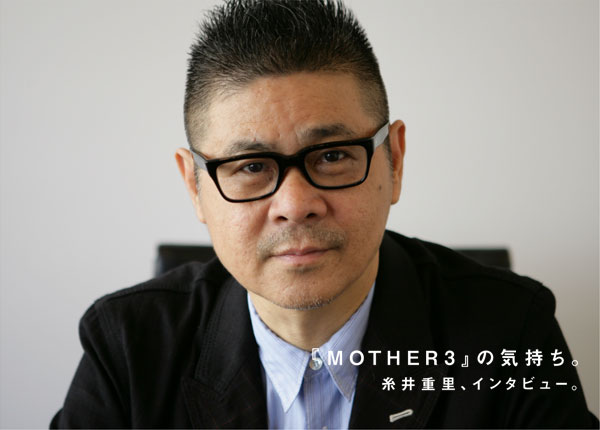
Restarting MOTHER 3
When I heard MOTHER 3 was being worked on again, frankly, I was surprised. And impressed.
- Itoi
- Three years ago. Yeah.
Development of the original MOTHER 3 had stalled, it went through an unprecedented public cancellation, there was enormous outcry from all kinds of people, and right when things seemed to have finally calmed down, it was all picked up from scratch.
- Itoi
- Looking at it objectively, yeah, I can see that. Not to mention Hobo Nikkan Itoi Shinbun had gotten on track, so while this is strange to say, I knew that staying away from making video games would be for the best for my work.
I agree. Of course, as a fan myself, I was genuinely over the moon. But as someone who knew firsthand the circumstances and magnitude of the cancellation, I couldn’t believe it was happening. It just so happened that the resumption of the game’s development happened right when I joined Hobonichi. Could you explain the lead-up to that decision?
- Itoi
- It all started when I was in Kyoto. I went to Nintendo on business, and after the meeting, I left and headed into town by taxi. Shigeru Miyamoto and Satoru Iwata were riding with me, and Miyamoto turns and says, “Would it be an option to release MOTHER 3 on the Game Boy Advance?”
So it wasn’t a request, or even a suggestion.
- Itoi
- Just “Is it an option?” To be frank, I didn’t know. But if I had to say yes or no about it technically being an option, it seemed possible. Looking back now, that was an incredibly frank conversation we were having. I, too, wasn’t thinking at that moment about how difficult things would be, or what we’d actually need to do. We were only thinking about whether it was an option. And by the time I got out of the taxi, I realized I was feeling happy. I was happy at the thought.
Yeah.
- Itoi
- Of course, it’s not that it all unfolded on a whim. We put an incredible amount of work into it beforehand. Both before and after the cancellation announcement, at every turn and opportunity we had, I was constantly talking with Iwata—who wasn’t yet president of Nintendo—about what kind of environment it would take for it to work, or what kind of options there were to move forward, if any. But in the end, it all began with that frank conversation in the taxi.
Although the idea of restarting development of MOTHER 3 was a happy occasion, were you scared about jumping back into that maelstrom?
- Itoi
- I was. One of the reasons was the fact that the original MOTHER 3 was designed as a cinematic epic. But the specs would be downgraded on the Game Boy Advance. It was like recreating this cinematic vision I had, using only construction paper. I didn’t have much confidence that I’d be able to pull it off. I mean, we relied on those specifications when we were creating the original MOTHER 3. I would think about it in terms of, say, a billow of sand swirling up in the wind.
At the time—that is, when the Nintendo 64 first came out—I’m sure as the creator, you saw that ability to portray things cinematically, and to enrich video games, as a good thing.
- Itoi
- Yeah. The idea of video games becoming more cinematic seemed strange to me, but at the same time, I was jealous. There’s a part of me that fills with joy to think, “If that’s possible, then so is this!” There were times that cinema helped me when I least expected it.
On the other hand, in making the game for the Game Boy Advance, it was immediately clear that there would be so much more weight on my role as the one overseeing it. That part was scary. You could say that it makes no difference where a show takes place as long as the script is good. But the idea of hosting the show in a small theatre made me nervous. We’d set the bar pretty high with that scenario.
I see.
- Itoi
- The fear and anticipated obstacles were overwhelming. But in the end, I told myself that if I could lock myself away for a month and write up the script and dialog, we’d be able to pull it off. And so I decided to go for it.